
Author

Pakistan’s Split State: The Case For Civil-Military Fusion
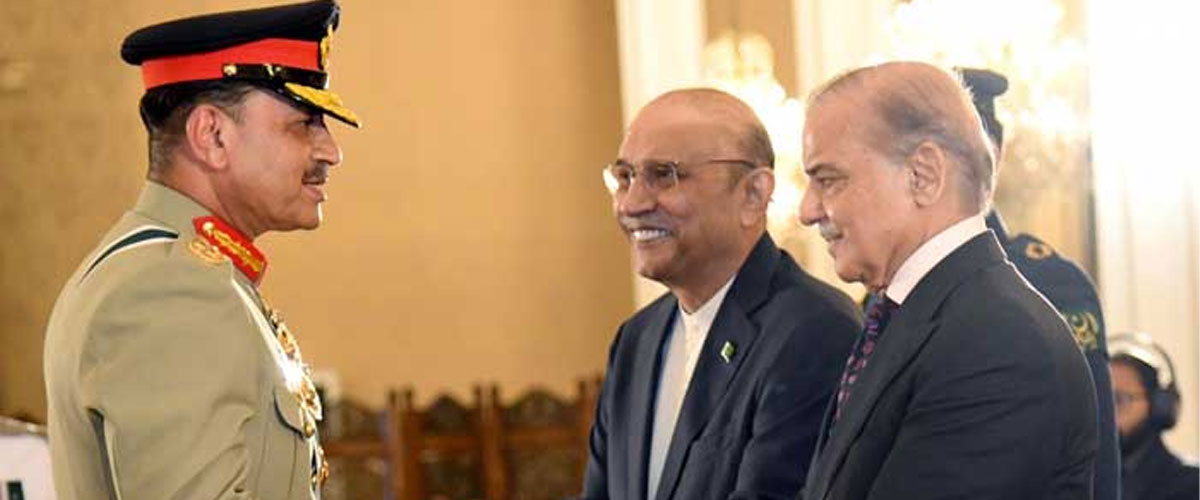
Pakistan is not suffering from a weak state, but from a split state—where authority and ability are divided. On one side, civilians have the paper authority, but lack the muscle to act. On the other, the military has the strength but lacks continuity and long-term strategy. This dual-power mess—where civilians make decisions without the means to enforce them and the military possesses the means without the legitimacy to command—is causing serious governance issues.
The problem is one of legitimacy and capability. Civilian governments struggle to assert their authority due to lack of military and institutional backing, while the military, despite its powerful infrastructure, often finds itself constrained by political instability and a lack of long-term strategic direction. The result is a dysfunctional system that fosters delays, blame games, and confusion at home. Meanwhile, enemies like the Tehreek-e-Taliban Pakistan (TTP) and the Baloch Liberation Army (BLA) exploit these seams in governance, while allies like Saudi Arabia and the UAE begin to hedge their bets, unsure of Pakistan’s stability.
The concept of civil-military fusion is not new and has been successfully implemented by many countries to ensure the effective integration of military and civilian functions. Take China, for instance, where the Communist Party has fused civilian technological capabilities with the modernization of the People’s Liberation Army (PLA). This integration has enabled China to become a global leader in areas such as shipbuilding, hypersonic missile development, and electric vehicle production, with an estimated $500 billion in annual dual-use output.
Turkey has also made strides in civil-military fusion. The National Security Council (NSC), which was established in 1962, serves as a platform where the civilian president, prime minister, and military chiefs collaborate on strategic decisions. Post-2016 reforms have further strengthened this integration, resulting in indigenous defense innovations like the ANKA and AK NC UAVs, T-129 ATAK attack helicopters, and the fifth-generation Kaan fighter prototype.
South Korea offers another compelling example. Through its National Security Office (NSO), established in 1987, the country has unified presidential command with military chiefs and economic ministries. This integration was crucial in 2017 when, within 30 minutes of a North Korean missile launch, South Korea activated its missile defense systems, protecting its $200 billion semiconductor industry without any losses.
Countries like France, Japan, and Singapore have also institutionalized civil-military coordination, creating systems that synchronize defense, intelligence, and economic strategies. For example, France’s General Secretariat for National Defense and Security (SGDSN) integrates military and civilian crisis management, while Singapore’s National Security Coordination Secretariat (NSCS) unites military, intelligence, and trade ministries.
In contrast, Pakistan’s duality has resulted in paralysis. The civilian government, despite holding the constitutional authority, struggles to translate its decisions into action. The military, with its immense resources, often operates in a disjointed manner without a unified long-term strategy. This lack of synchronization weakens the state and leaves it vulnerable to external threats and internal fragmentation.
Enemies, such as militant groups, thrive on this confusion. They exploit the gaps between civilian and military authority to further their agendas. At the same time, Pakistan’s allies grow wary. Countries like Saudi Arabia and the UAE, once strong supporters, are now more cautious in their approach, unsure of Pakistan’s ability to deliver on promises or secure its own future.
What Pakistan needs is not more military control but an integration of civilian and military functions. Civil-military fusion would allow Pakistan to synchronize priorities, streamline procurement, and enhance its crisis response capabilities. This fusion is not about political dominance—whether civilian or military—but about creating a system where both civilian and military authorities work in harmony, sharing resources, information, and strategic objectives.
Countries like China, Turkey, South Korea, France, Japan, and Singapore have successfully institutionalized such integration, and the results are visible in their economic and military successes. In Pakistan, the lack of an integrated decision-making system—what some might call an “OODA loop” (Observe–Orient–Decide–Act)—is the key barrier to progress. In simple terms, it’s about reducing friction in the decision-making process, ensuring that the state can respond rapidly and effectively to challenges, whether in times of peace or conflict.
By fusing civilian and military functions into a single coordinated framework, Pakistan could eliminate the current siloed structure that leads to delays and confusion. Think of it as welding two rifles into a single sniper system: when the military’s strength and the civilian authority are aligned, the result is greater precision and power, with no “friendly fire” between the two. This clarity, this force-multiplication, is what Pakistan urgently needs to become a more resilient state—one that can act decisively in times of peace and project power during conflict.
Pakistan does not lack resources, courage, or potential. What it lacks is an integrated system of governance that aligns authority with capability. Civil-military fusion is the missing link. It is not about turning Pakistan into a militarized state, but about harmonizing the roles of civilians and the military in a way that enhances national resilience and efficiency. This fusion is what will allow Pakistan to overcome its governance challenges and emerge as a stronger, more cohesive nation.
By following the example of successful nations around the world, Pakistan can eliminate the paralysis caused by its split state and move toward a future where authority and ability meet. Only then can Pakistan truly realize its potential on the global stage.