
Author

Board of Peace Comes Into Force After 19 Countries Including Pakistan Signs its Charter
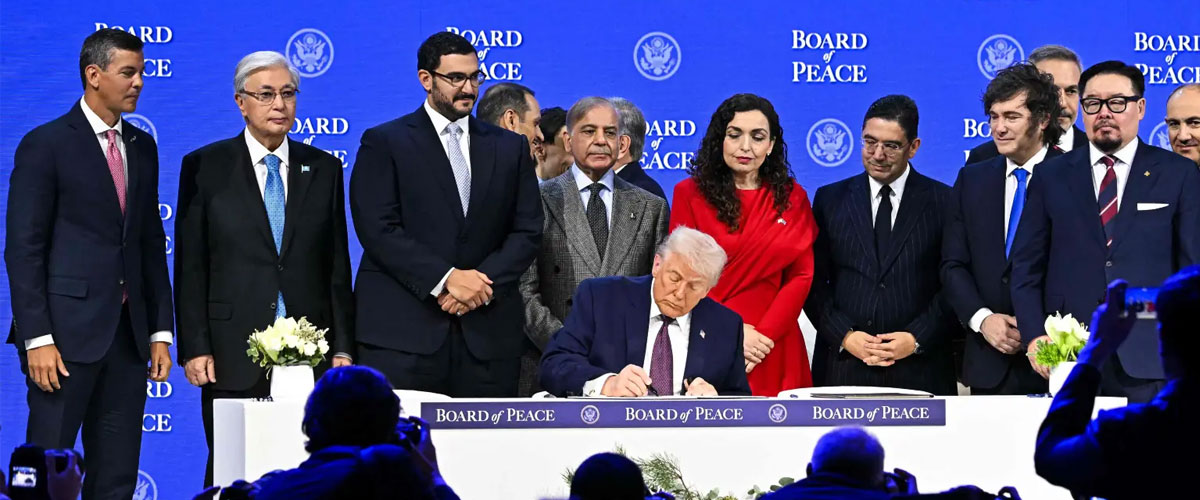
ISLAMABAD: A group of leaders of 19 countries including Pakistan formally signed the Charter of Board of Peace, which US President Donald Trump has proposed as an international body for conflict resolution, in Davos where President Trump formally announced its coming into force.
Prime Minister Shehbaz Sharif signed the charter for the “Board” headed by United States President Donald Trump, who announced that the body would act as a forum for resolving international conflicts.
Originally meant to oversee peace in Gaza under the United Nations Security Council mandate, the board’s charter now omits reference either to Gaza or UN Security Council resolution. The charter envisions a wider role in resolving international conflicts.
A group of leaders and senior officials from 19 countries — including Pakistan — gathered on stage with Trump at a signing ceremony in Davos, Switzerland to put their names to the founding charter of the body.
“Congratulations, President Trump. The charter is now in full force, and the Board of Peace is now an official international organisation,” White House Press Secretary Karoline Leavitt said.
The Pakistani ruling party faced scathing criticism for its decision to join the Board of Peace as the religious leaders in parliament came down hard on the government benches.
Taking part in the debate in the national assembly Parliamentary Affairs Minister Dr Tariq Fazal Chaudhry said Pakistan had a principled position on the Palestine issue and always raised it at international forums.
He said Pakistan’s decision to join the board was guided by national interest and the collective priorities of the Muslim Ummah, not political considerations.
He noted that UN Security Council resolutions called for a permanent ceasefire and reconstruction of Gaza, adding that Pakistan’s participation in the board aimed to support these efforts while safeguarding both Palestinian and national interests.
Meanwhile, Jamiat Ulema-i-Islam Fazl (JUI-F) Chief Maulana Fazlur Rehman warned Pakistan against becoming part of any campaign to disarm Hamas. He said that those responsible for the Palestinians’ plight were part of the board.
“Expecting peace from Trump tantamounts to living in [a] fool’s paradise,” he said on the floor of the house.
During the Charter signing ceremony the US president emphasized that Hamas must disarm under the Gaza ceasefire deal or it will be the “end” of the Palestinian movement. “They have to give up their weapons, and if they don’t do that, it’s going to be the end of them,” Trump said. “We’re committed to ensuring Gaza is demilitarized, properly governed and beautifully rebuilt,” he affirmed, adding that “we can spread out to other things as we succeed with Gaza”.
Pakistan’s adherence to the United Nations (UN) and its participation in President Trump’s Board of Peace (BoP) are being navigated through a policy of “parallel engagement” rather than direct conflict. Pakistan maintains that the BoP is an instrument to implement UN mandates, though critics and some international observers suggest the two bodies may eventually clash.
Pakistan has put two conditions for sending its troops to Gaza for participation in Peacekeeping operations. Firstly the peacekeeping must be mandated by United Nations Security Council and second Pakistan troops would not take part in disarming HAMAS and other Palestinian resistance groups.
Major European countries have declined to join the Board of Peace saying it is a threat to rule based order. European allies and some Pakistani analysts express concern that the BoP is designed as a rival to the UN.
If the BoP begins to operate unilaterally or bypasses the UNSC on issues like Gaza’s demilitarization, Pakistan’s historical commitment to the UN Charter would be tested. Pakistan has clarified that any troop deployment would require a clear UN mandate, the aspirations of the Palestinian people, and national interest. A clash could occur if Trump pushes for an ISF deployment through the BoP that lacks a formal UN peacekeeping structure.