
Author

Why Has India Not Joined The Board of Peace So Far?
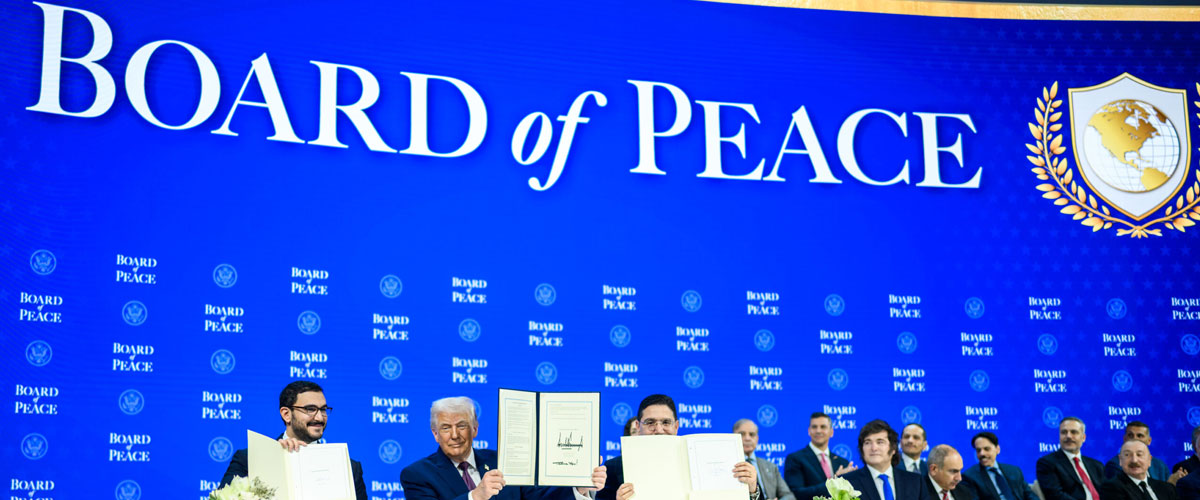
ISLAMABAD: Indian Prime Minister Narendar Modi was conspicuous by his absence from the Board of Peace Charter signing ceremony in Davos, where 19 heads of governments of states signed the document issued by White House last week.
With the completion of the signing ceremony presided over by US President Donald Trump, the Gaza Board of Peace came into force. The BoP was initially conceived and approved by the UN Security Council as a governing body for war torn Gaza. Later the Charter issued by the White skipped the mention of both Gaza and the UN Security Council Resolution, which, initially, led to its formation.
Along with dozens of other countries, India also received an invitation for joining the Board of Peace (BoP) but so far the government of India or its Ministry of External Affairs didn’t clarify its position with regards to the invitation sent to India.
Seven Muslim countries including Saudi Arabia, UAE, Turkey, Jordon, Qatar, Egypt and Pakistan issued a joint statement containing the acceptance of President Trump’s invitation.
The Board of Peace was initially established for stabilizing war torn Gaza, however later President Trump started to project the body as a forum for the resolution of international conflicts.
Indian media and analysts have expressed the fear that President Trump might use the Board of Peace as a forum to intervene in the Kashmir conflict. On multiple occasions President Trump has expressed the wish to mediate between Pakistan and India on the Kashmir conflict–an idea deeply detested by the Indian government.
There is a widespread fear among foreign policy experts and practitioners world over that President Trump might use the forum of the Board of Peace as a rival to the United Nations Security Council, which, since the conclusion of the Second World War, has been dealing with international conflicts.
India’s leading English language newspaper, The Hindu newspaper dubbed Pakistan’s decision to join the board as “a warning signal to India”. The newspaper pointed out US president’s enthusiasm to playing the ‘peacemaker’, having already claimed to have solved multiple regional and global conflicts during his first year in office.“…[I]f Trump decides to include the Kashmir dispute in [his] peace plans, the Peace Board will try to resolve it”.
Pakistani foreign policy experts believe that New Delhi is wary that the board’s mandate, which recently expanded from Gaza reconstruction to resolving “contested areas,” could be used by the U.S. to mediate the Kashmir dispute. India has historically maintained that Kashmir is a bilateral issue with Pakistan and firmly rejects any third-party intervention.
India has always rejected mediation offers on Kashmir from a third party including the United States and United Nations repeatedly during the last 78 years.
Indian foreign policy experts and practitioners in their newspaper columns have expressed concern that the BoP is designed as a parallel or rival entity to the United Nations. India has a long history of supporting the UN framework and views the board as potentially weakening international multilateralism.
Left-leaning parties in India have publicly urged the government to reject the invitation, labeling the board a “betrayal of the Palestinian cause” and an instrument of U.S. imperial interests. India has not officially rejected the Board of Peace to avoid annoying the Trump administration during delicate trade talks. In other words it is keeping its position ambiguous.