
Author

The Abraham Accords and Palestinian Resistance: A Slogan of Peace or a New Regional Alignment?
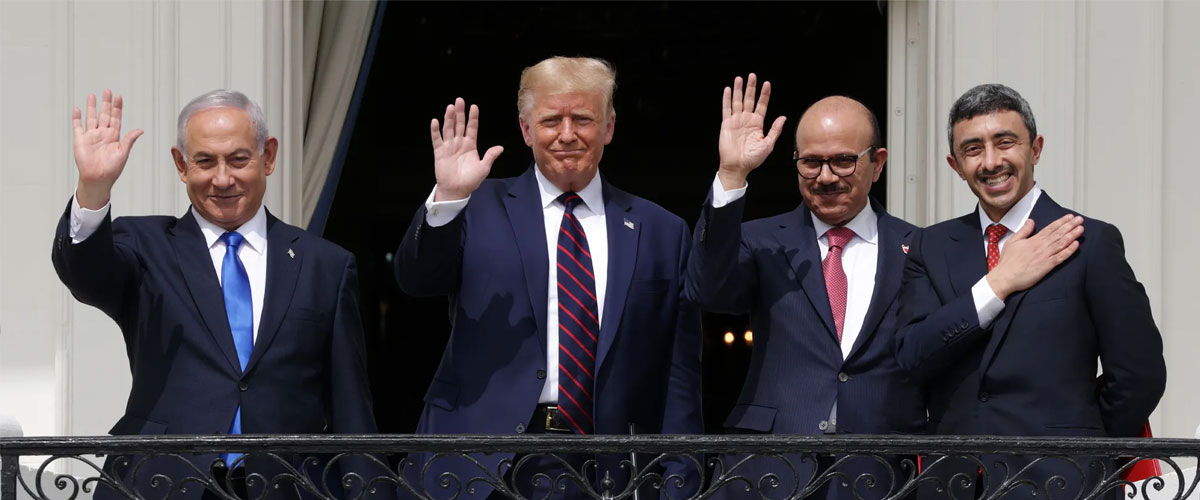
The politics of the Middle East has always revolved around conflict, wars, and claims of peace. At times, peace initiatives are introduced, and at other times, new political arrangements are established in the region through agreements. In recent years, two terms have been repeatedly heard: the Board of Peace and the Abraham Accords. Although both appear to be linked with peace, in reality, there is a world of difference between their objectives and their consequences.
Meanwhile, Pakistan’s Foreign Office spokesperson stated that Pakistan joined the Gaza Board of Peace with sincerity. Along with Pakistan, seven other major Muslim countries have also become part of the Board of Peace. Through this platform, Pakistan seeks peace in Palestine and joined the initiative to contribute to the reconstruction and improvement of Gaza.
He emphasized that allegations linking the Board of Peace to the Abraham Accords are baseless. The Gaza Board of Peace has no connection with the Abraham Accords. Pakistan remains hopeful regarding the implementation of the Board of Peace framework. Pakistan supports the establishment of an independent Palestinian state along the 1967 borders, with Al-Quds Al-Sharif (Jerusalem) as its capital.
Tahir Andrabi stated that Pakistan joined the Board of Peace in good faith. The purpose of this participation is to strengthen the ceasefire in Gaza. The second objective is to assist in the reconstruction of Gaza, while the third is to establish lasting peace based on the Palestinian people’s right to self-determination.
The spokesperson further noted that Pakistan is not alone—seven other Muslim countries are also part of the Board of Peace, including Saudi Arabia, Egypt, Jordan, the UAE, Indonesia, and Qatar. The Board of Peace was launched collectively in September last year. It is being viewed as a ray of hope for Gaza and the Palestinian cause.
He added that for the past two years, the people of Gaza have suffered massive destruction and a severe humanitarian crisis. The efforts of the United Nations have failed to stop Israeli aggression. The Board of Peace has been approved under a United Nations Security Council resolution. It is not an alternative to the UN, but rather a supportive platform.
Tahir Hussain Andrabi clarified that associating the Board of Peace with the Abraham Accords is a misunderstanding. Pakistan will not become part of the Abraham Accords, and no decision has been made regarding joining any international stabilization force.
Now, first of all, the Board of Peace is not a single specific international agreement but rather a general concept. Different countries and organizations establish committees or platforms for peace negotiations, often referred to as peace boards or Boards of Peace. Their aim is to resolve conflicts, facilitate dialogue, and bring parties to the negotiating table. It may be an institutional effort, but it does not always have a clearly defined political direction.
In contrast, the Abraham Accords are a clear and concrete political agreement concluded in 2020 under US sponsorship. Under these accords, the United Arab Emirates, Bahrain, Morocco, and Sudan established diplomatic relations with Israel and announced normalization of ties. This agreement was presented as progress toward peace, but the real question remains: peace for whom?
From the Palestinian perspective, the Abraham Accords are not a path to peace but rather an attempt to push the Palestinian struggle into the background. For decades, the Arab world maintained a fundamental position that relations with Israel would not be possible until Palestinians received their rights. However, the Abraham Accords effectively ended this principle in practice.
The greatest impact of these accords was that the Palestinian issue was pushed down the list of priorities in the Arab world. Israel not only gained diplomatic acceptance but also found an opportunity to further strengthen its position in the region. The Palestinian resistance movement, already under immense pressure, began to face even greater isolation.
With weakened political support, resistance groups encountered increasing difficulties—Israeli pressure on one side and shifting Arab alignments on the other. This is why some analysts believe that as the prospects for a political solution decline, the tendency toward intensified resistance may grow stronger. When the doors of negotiations close and diplomatic backing weakens, resistance often becomes more entrenched.
The Abraham Accords also generated disappointment among the Palestinian people. They felt that countries they once considered natural allies in their struggle were now standing alongside Israel in pursuit of their own interests. This disappointment, at times, also provides new energy to protests and resistance.
The question here is not whether peace is necessary in the region—peace is undoubtedly the need of every nation. The real question is whether such peace is possible if it ignores the fundamental rights of the Palestinian people. Can the issue of justice be resolved simply by establishing diplomatic relations?
The reality is that the Abraham Accords represent a new regional alignment that has weakened the Palestinian cause. Until the Palestinian issue is resolved with justice, all peace plans in this region will remain nothing more than paper claims.
The path to peace always passes through justice, and without Palestine, any peace in the Middle East will remain incomplete.