
Author

Pakistan’s War Within and Without: From Islamabad Bombing to Cross-Border Strikes, A Security Crisis Spirals
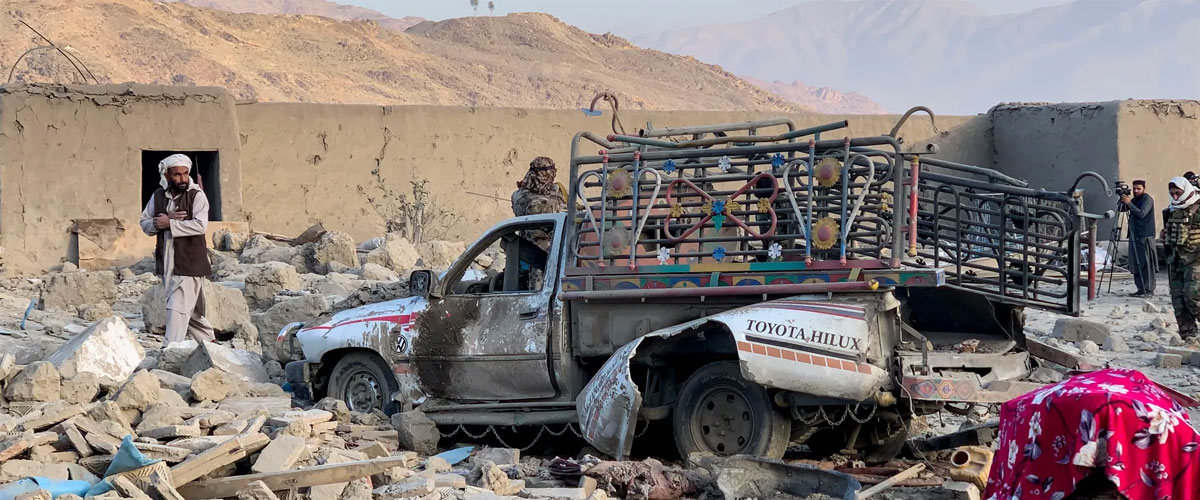
Islamabad: Two weeks after a suicide bomber tore through a Shia Imambargah in Islamabad, killing over 30 worshippers in the heart of the federal capital, Pakistan has been hit by a cascading wave of violence – with fresh suicide attacks in Bannu and Bajaur, insurgent kidnappings in Balochistan, and retaliatory airstrikes inside Afghanistan. The Islamabad bombing, claimed by the Islamic State and followed by attacks blamed on the Tehreek-i-Taliban Pakistan, has triggered an escalating cycle of militant strikes and cross-border retaliation, exposing the widening arc of instability and raising uncomfortable questions about Islamabad’s growing reliance on air power to compensate for persistent intelligence and policing failures at home.
Officials confirmed on Sunday that 14 labourers working with private construction contractors were abducted by armed men in Khuzdar and Barkhan districts Balochistan. Eleven were taken from Khuzdar and three from Barkhan, both long-running hubs of Baloch insurgent activity. No group immediately claimed responsibility, but the pattern fits the strategy of ethnic Baloch separatist outfits, which increasingly target non-local labourers and infrastructure workers to deter federal-backed development projects, particularly those linked to strategic road networks.
Security officials, speaking on condition of anonymity, said the kidnappings were “well-planned and intelligence-driven,” suggesting insurgents had prior knowledge of the workers’ movements. This reflects a growing operational confidence among insurgents despite repeated military clearance operations. Independent analysts note that enforced disappearances and heavy-handed security measures have deepened local resentment, creating a recruitment pipeline for militant groups.
At the same time, Pakistan’s military escalated its aerial campaign inside eastern Afghanistan, conducting strikes in Nangarhar and Paktika provinces. Pakistan’s military said it targeted “seven terrorist hideouts” belonging to the banned Tehreek-i-Taliban Pakistan (TTP), which Islamabad blames for recent suicide attacks in Bannu and Bajaur regions of Khyber Pakhtunkhwa province. The latest escalation in the country’s northwest and south west was preceded by a deadly attack on Imambargah in Islamabad.
However, the Taliban government in Kabul accused Pakistan of killing civilians. Local officials in Nangarhar said 13 bodies, including children and women, were buried Sunday in the Kardikus area. Afghanistan’s defence ministry warned that it would respond “at an appropriate time,” a phrase widely interpreted by regional diplomats as a calibrated but serious warning.
Former Afghan president Hamid Karzai condemned the strikes as a violation of sovereignty, saying, “Such actions only deepen mistrust and suffering.” Former chief executive Abdullah Abdullah also criticised Pakistan, urging dialogue “to live like good neighbours rather than escalating conflict.”
The strikes highlight a dangerous normalization. Since late 2023, Pakistan has increasingly resorted to cross-border air power following major militant attacks, effectively formalising a doctrine of unilateral retaliation. Pakistani officials privately argue that Kabul has failed to curb TTP sanctuaries, leaving Islamabad with “no other option.”
But security experts say the policy reflects strategic frustration rather than strength.
“Airstrikes create optics of action but rarely dismantle insurgent networks,” said a Peshawar-based counter-terrorism researcher. “Instead, civilian casualties strengthen anti-Pakistan sentiment inside Afghanistan and indirectly benefit the TTP.”
Western diplomats monitoring the region say there is no evidence the strikes have significantly degraded the TTP’s operational capability. Instead, the group has demonstrated expanding reach, carrying out high-profile attacks deep inside Pakistan, including in the federal capital.
The simultaneity of crises in Balochistan and along the Afghan frontier underscores a deeper structural problem. Pakistan is now confronting two distinct insurgencies – one ethno-nationalist and secular, the other Islamist and transnational – both exploiting governance vacuums and local grievances.
“The state is caught in a reactive security cycle,” said Nazrul Islam, an Islamabad-based analyst. “Each attack triggers a military response, but the underlying political conflicts remain unaddressed.”
Perhaps most worrying for Pakistani planners is the diplomatic cost. The Afghan Taliban, once seen by Islamabad as a strategic ally, is now openly accusing Pakistan of aggression. This marks a dramatic reversal in relations since the Taliban’s return to power in 2021.
With insurgent violence rising, cross-border strikes escalating, and provinces like Balochistan slipping further from effective state control, Pakistan faces the prospect of a widening conflict landscape – one where military force is increasingly used, but stability remains elusive.