
Author

Samson’s Shadow Over The Nuclear Order
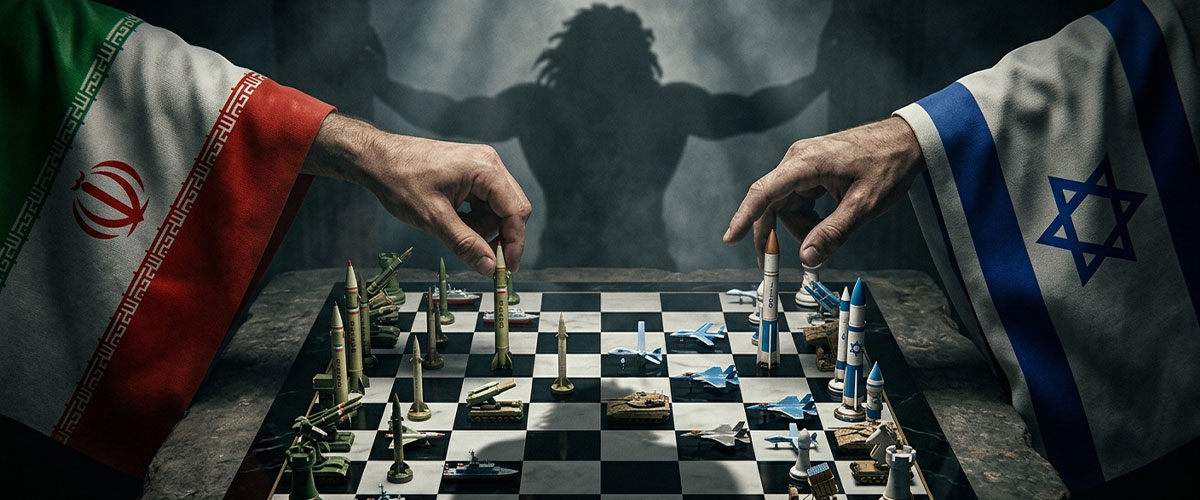
Western and Israeli military experts have started mentioning “Samson’s option” as a possible option for Israel in its war with Iran.
Reported Iranian missile attacks on the Israeli city of Dimona, where the Israeli nuclear weapons program is physically located, have reignited the debate about use of “Samson’s option” by Israel.
No serious Western outlet is discussing this possibility. But both Israeli and Western military and strategic experts brought in the mention of Samson’s option as at least a theoretical possibility in the Iran war, if not an imminent one. “Samson Option” is a term used to describe Israel’s last-resort nuclear strategy. It is an idea that if Israel faces destruction, it will retaliate with overwhelming force, potentially using nuclear weapons even if it meant massive regional or global devastation. It is not part of the official nuclear policy of the state of Israel. However, the very fact that serious military and strategic experts are now discussing Samson’s option as a possibility, even if theoretical one, makes my skin cold.
The US emerged as the most powerful country in the post-World War-II situation with both the soft and hard power to influence the process of norms and traditions formation in the post war international order. Nina Tannenwald is an American author who narrated the story of how “Nuclear Taboo” was constructed in the post-World War-II international politics. She argues that since the bombings of Hiroshima and Nagasaki in 1945, nuclear weapons have not been used again—not just because of deterrence or military strategy, but because their use has become morally unacceptable.
This process of construction of nuclear taboo was facilitated by public opinion, Anti-nuclear movements, Diplomacy and arms control efforts and Political leaders’ decision to avoid nuclear use even when it might have been militarily useful. For example, in Korea and Vietnam.
The framework promoted by Tannenwald in her works emphasized that nuclear norms don’t sustain themselves, rather they are actively promoted. Bill Clinton was the first US President who assumed power in Washington after the end of the Cold War. This meant under his Presidency the US was no longer facing a nuclear competitor in the form of the USSR. This allowed Clinton to De-emphasis’ role of nuclear weapons in international diplomacy and military strategy. His administration Reduced the salience of nuclear weapons in US military doctrine, and he promoted the idea that nuclear weapons are weapons of last resort, not usable battlefield tools.
There was much talk about applying the lesson of “nuclear taboo” construction in American politics and in the post-Cold War world in South Asia. Experts were convinced that the Nina Tannenwald framework would serve both the South Asian rivals of Pakistan and India
After Iranian missiles hit Israel nuclear plants and in reaction Israeli and western experts started mentioning “Samson’s option”, I recalled that this was not the only sign that the edifice constructed around nonuse of nuclear weapons have started to erode during the past five to ten years. Nuclear taboo was that no nuclear state has ever launched even a conventional attack on another nuclear state.
On May 7, 2025, India, a nuclear state, launched a conventional attack on another nuclear state, Pakistan. Since the Ukraine war many non-nuclear states or entities have attacked nuclear states. For instance, Ukraine attacked Russia. Iran attacked Israel. HAMAS attacked Israel. Henry L Stimson used to argue that nuclear states should not attack or threaten to attack non-nuclear states. We now know that Israel and the US attacked Iran. Russia attacked Ukraine. Donald Trump did say that Israel would not use nuclear weapons, at least publicly during the current crisis, “Israel wouldn’t do that. Israel would never do that”.
Even if we accept the notion that the use of nuclear weapons by Israel is not imminent, we will have to note that in Israel the debate about existential threats to the survival of the Israeli state and society are rising. And as a corresponding reality Israeli military and strategic experts are mentioning “Samson’s option as a possibility. The nuclear taboo was built assuming rational restraint—but it was never fully tested against asymmetric existential fears.
In a situation in which Iran finds itself it will learn the same lesson Pakistan learned in its contest with much powerful military power, India. For Iran only nuclear weapons can ensure its territorial integrity in the face of enemies who are armed to the teeth. Here morality can hardly play any role. The problem at hand is not that nuclear weapons will be used tomorrow. The central problem is that the very idea of using them is again becoming thinkable.