Author

The Death of Jang And The Collapse of Pakistan’s Old Media Order
As Pakistan’s largest newspaper faces possible closure, an entire 20th century model of media ownership, patronage and controlled dissent is nearing its end.
For generations of Pakistanis the Urdu language Daily newspaper, Jang was indispensable part of their lives. They believed it would always exist.
In the uncertain political environment of our country, governments came and went, military coups happened, even dictators, who appeared indispensable, went away, television came, internet disrupted conventional media. But Jang survived all this.
Today for the first time, in our history, it is not impossible to see that Pakistan’s largest newspaper will not remain financially and economically viable.
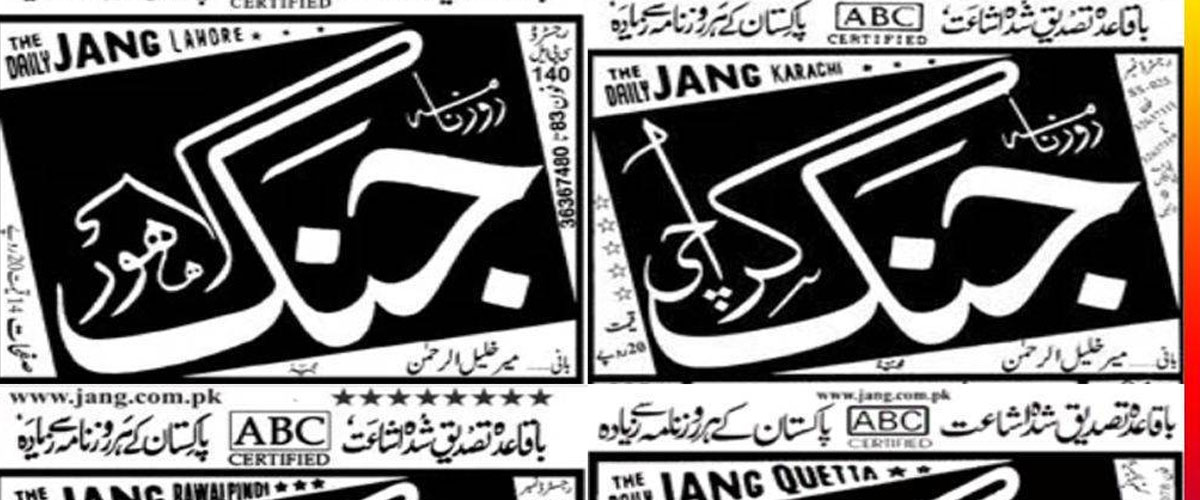
Reports circulating in the media indicate that Jang will cease its publication in the next six months. Other reports have been pouring in indicating the staff lay off, salary deduction and delays, closure of affiliated publications and shrinking print economics in the three editions of Jang newspaper coming out from Lahore, Karachi and Rawalpindi.
There was a time when Jang used to represent the vibrancy of Pakistani print media industry. For decades it acted as mirror of Pakistani society. No matter how distorted and occasionally perverted image of social and political reality it presented to the masses, its status as a mirror of the society remained
unchallenged for decades after Pakistan’s independence. Its editorials used to be talk of the town and its columnists were the star figures in the media world of 1980s and 1990s.
The strategies of survival that once protected family run media empires in Pakistani society are now collapsing. The crisis of Pakistani print media industry is not simply a crisis of one newspaper. It reflects the process of coming to end of an entire 20th century media model in media industry.
Three politically influential families–the Nizamis, the Haroon and the Mirs—built media houses in the pre-independence period and managed to survive till the present. Whatever may be the shortcoming of these media houses, all of them were built on the premise of commitment to some kind of public philosophy and social responsibility.
During the last 20 years the media expansion that took place in our society came from investors whose prime interests lay elsewhere: political patrons, contractors, industrial groups and other networks of inventors and capitalists who perceived media ownership less as a civic responsibility and more as a source of influence within the power structures of society.
The recent years have seen large scale investment in the media industry coming from real estate businessmen who see journalism less as a public institution and more to expand their commercial and political power. These media houses and their owners are timid and socially irresponsible. They succumb to state pressure too easily. They have hired media personalities who are in bed with the state machinery and very gullible in terms of the content they produce.
The three media houses—Jang, Nawa-e-Waqt and Dawn group– have been in the field since before the creation of Pakistan, were built on the model which is dying in the face of pressures from the digital media and state machinery.
These family- newspaper empires have been sustaining themselves financially primarily on the model that revolves around cross-subsidies, political access, state advertising, influence-based economics, and patronage networks. These media houses were not simply journalist institutions; they are political instruments and influence networks.
These print media platforms have been destroyed and are breathing their last on account of several pressures:
• The young generation (Generation Z), which forms the largest section of literate people in our society, has completely abandoned print as a source of information. This is a big jostle to the print media industry
• Economic crisis that Pakistan finds itself in, is a big source of print media’s decline. However, this is coupled with the fact that digital platforms have usurped most of the sources of advertisements both globally and at the national level.
• Worldwide there are newspapers like The New York Times which increasingly rely on a subscription-based model rather than traditional advertising. In Pakistan subscription culture is almost non-existent.
• The state and the government have become completely intolerant of any kind of dissent. Traditionally in Pakistani journalism, it was the institution of newspaper which hosted country’s leading dissenting voices in different points of time in our history. The governments are now not ready to tolerate dissent and yet subsidize the operations of newspapers.
All this meant shrinking circulation of newspapers, which in turn meant neither private companies nor government would be advertising in newspapers with dwindling circulation. Historically, newspapers in Pakistan depended heavily on classifieds, print advertisements, corporate ads, and government ads. All this business was going elsewhere.
Economic and financial dependence weakened editorial courage of newspaper industry even in its heydays. In the time of crisis this lack of courage turned into timidity. For example, when a five-star hotel room caught fire in Karachi recently, none of the newspapers had the courage to mention the name of the hotel on the first day of reporting, fearing it could cost them advertisement cuts. When scion of a leading business company crashed a family of three on the roads of Karachi recently, the leading English newspaper, Dawn didn’t show the courage to mention the name of this business house in its first reports it published. Only after social media raised clamor about the involvement of business executives in securing the release of culprit drivers that newspapers in Karachi started to mention the name of the business house.
The extent of pressure of the state machinery on Pakistani newspapers became visible only after May 2025 conflict when these newspapers—which were once hosts of critical and dissenting voices in the society—started reproducing state propaganda on their pages. This also reflected the reality that these newspapers have been arm twisted into submission.
In the wake of May 2025 conflict started Pakistani state media managers have become opium producing factories for the masses—what they are showing to the public and what they are helping media to producing is not less than opium for the masses. The economically and financially dependent media has no option but to act as a transmitter of this opium like content, erroneously showing Pakistan invincible military power in quite funny ways. The model, where media houses are completely dependent on advertisement revenues from state and private sector, can hardly accommodate any dissenting or alternate voices in the pages of newspapers.
Pakistani newspapers survived authoritarianism and military dictatorship. It seemed They will not survive economic irrelevance.
It is time for the journalists to invent a new model of media ownership. We have many examples from Indian society where advertisement from vested interest is not the source of revenue for the media outlet. In Indian society several digital outlets have emerged which are experimenting with reader-funded journalism, subscription models and philanthropic support structures.
There is little doubt that the old model is collapsing and the thing is that this raises a larger question for Pakistani media industry: who will finance dissent in a political economy where both the state and private sector only reward obedience? Unless journalists in Pakistan develop a new reader supported model which is institutionally and financially independent of state and corporate sector the death of newspapers like Jang will not only mark the end of media industry but also the shrinking of institutional space for public debate in Pakistani society.