Author

Pakistan’s Diplomatic Triumph, Journalism’s Failure
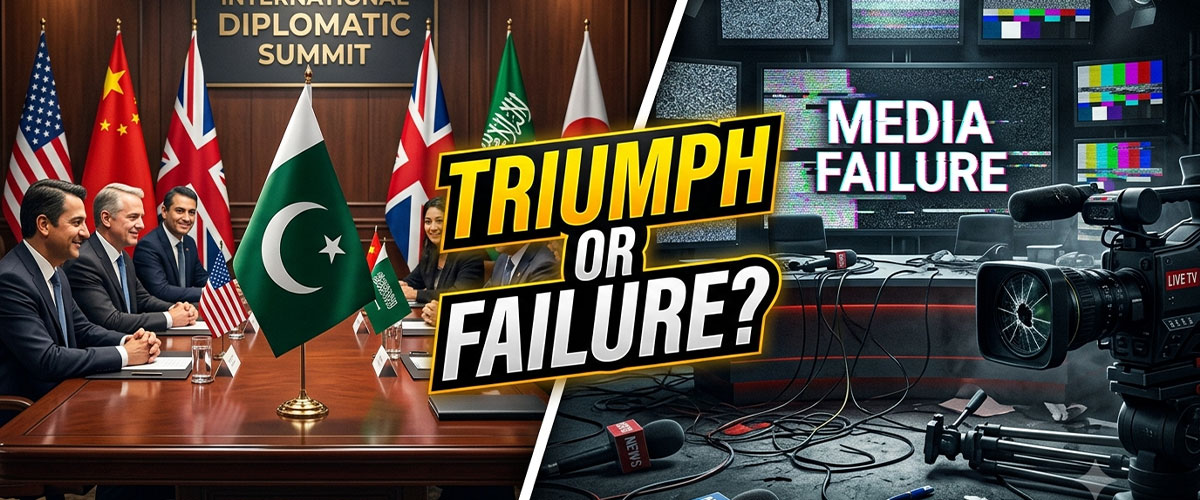
ISLAMABAD: The reported role of Pakistani military and political leaders in bringing about a US-Iran peace agreement was arguably one of the most crucial diplomatic stories about Pakistan in decades. Yet anyone relying on Pakistani media for information about Pakistan’s role in the negotiation would be at a loss to answer basic questions.
What exact role did Prime Minister Shehbaz Sharif and Field Marshal Asim Munir play in the talks? What strategic interests brought Tehran and Washington to the negotiating table? What compromises were made in the talks? What exactly did each side gain from the agreement?
Audiences were instead fed on the continuous stream of praises for Pakistan’s political and military leaders and claims of diplomatic triumph for Pakistan. In this short period Pakistani media converted the claim of Pakistan’s diplomatic success into a cliché.
Journalists’ first responsibility is to inform their readers and not to enhance the prestige of political and military leaders. Diplomatic reporting is not about presenting claims listed in the official statements. The purpose of diplomatic reporting is largely considered to explain the negotiations, identify political, economic and strategic interests of the negotiating parties, uncover disagreements between them, and to test official claims in the light of available evidence.
It is common journalistic practice around the world that diplomatic reporting puts developments in the negotiations in the larger geopolitical context. Similarly, the diplomatic reporting tries to reconstruct the bargaining process that takes place in the talks. For this purpose, the reporters seek information from multiple sources.
What Pakistani media has been doing stands in complete contrast with the universally accepted practices of journalism. Pakistani journalists appeared more interested in celebrating the diplomatic success than in informing the public how this diplomatic success was achieved.
I will offer two explanations for this unimpressive performance of Pakistani journalists in covering US-Iran talks and Pakistan’s role in these talks.
Firstly, diplomatic negotiations are inherently secretive. This element of secrecy is amplified in our case as in Pakistan information is tightly controlled by the official institutions. As a result, journalists are greatly dependent on official statements and briefings as the source of information in diplomacy.
When access depends on maintaining close relations with the authorities, the urge to be skeptical about received information give way to official narratives’ repetition in reporters’ copy.
Secondly, the Pakistani media industry doesn’t offer their diplomatic correspondents any opportunities to acquire experience in reporting diplomatic events and negotiations. Diplomatic correspondents in Pakistani media spend most of their time covering press conferences, reporting official statements and military briefings. And if some of them gain access to powers that be, they often become the channels through which inspired leaks are planted in the media.
In case of Pakistan’s role in the US-Iran talks the reporting in Pakistani media became excessively celebratory, therefore both political and military leaders escaped scrutiny, mistakes remained hidden and went unnoticed, there had been little comprehension of what this diplomatic success meant for Pakistan and public debate became extremely superficial.
For instance, it is not uncommon to see commentators on Pakistan electronic channels demanding loans to revamp the country’s economy in return for what Pakistan did for Washington and Tehran. In such a pathetic display of triumphalism genuine diplomatic achievements suffered as well. Excessive praise doesn’t enhance the understanding of common Pakistanis about what Pakistan gained from these talks.
Good analytical diplomatic reporting would not have diminished the diplomatic success of Pakistan’s foreign policy. It would have validated that success. But just like any other sphere, we have quite painstakingly destroyed all our journalistic institutions. For instance, the once very powerful institution of editor has been destroyed by the twin forces of financial pressures and highhandedness of the state machinery.
Editor used to act as a gatekeeper in the olden times, who protected news organization from outside pressures and enforced certain discipline on the journalists who were responsible for information gathering and presentation of news to the public. News organizations are now a thoroughfare where state machinery enjoys direct influence on the functioning of the newsroom.
Newsrooms are now under the control of those who run the finances of the news organizations and not under the control of professional editors. These financial managers are more vulnerable to the pressures from the state machinery and especially the intelligence agencies. So, the beat of diplomatic correspondents goes to the person who is either the favorite of the premier intelligence agency or ISPR. It was these institutions which handpicked diplomatic correspondents to be sent to Switzerland for covering the technical level US-Iran talks last week.
Professional editors had no role in the decisions.
Organizationally, the structures of Pakistani media outlets lie in tatters—completely destroyed by the financial pressures that accompanied the onslaught of electronic and digital media in the Pakistani media industry.
Second one, which coincided with the first, was even more devastating. Pakistani intelligence and another military institution—which for all practical purposes is effectively an intelligence agency—yes, I mean ISPR’s penetration into newsrooms. In this situation If I recommend the goody goody ideas like dedicated foreign policy correspondents and diplomatic training for reporters, it will appear naïve.
A cursory analysis of Pakistan’s media reporting of US-Iran talks makes it clear that hardly anyone in Pakistani media understands the role played by Pakistan’s political and military leaders in US-Iran talks. These talks were an excellent opportunity for Pakistani media to demonstrate its maturity. Instead, the content and nature of reporting in our media exposed an uncomfortable reality: Pakistan at present is developing major diplomatic ambitions for itself and yet its media is ill-equipped to explain that role to the world.
If Pakistan wants to be taken seriously as a diplomatic actor on the world stage it needs to have a media which can report diplomacy seriously. Otherwise, we will continue to celebrate historic events without properly understanding their meaning.