Author

Iran Welcomes Makkah Pact as Sign of Shifting Regional Security Perception
ISLAMABAD: Iran foreign ministry spokesperson said in that the Joint Defense Pact between Pakistan, Saudi Arabia and Turkiye showed a “change in perception” towards US role in regional security.
The spokesman said further said Iran has “deep ties with Turkiye, Pakistan, and even Saudi Arabia, and there was no reason to be concerned about the Makkah Pact.
Iranian media quoted the spokesman as saying that regional countries have “realized over the past three years that security is not a commodity to be purchased from false brokers”.
“Any plan that is based on facts and correctly identifies the enemy and the threat will contribute to regional security and prevent instability from the Zionist enemy,” he added.
This region doesn’t need players from outside and this development in itself must attract attention,” Iranian foreign ministry’s spokesperson said.
“The region must not be left under the illusion of achieving security through America. America is part of the lack of security in the region,” he was quoted as saying by the Iranian media.
He further said that the US creates the conditions for Israel to wage war with impunity.
“The Americans are supporting the Zionist entity politically and on the security level; without the Americans, the Zionist entity will never be able to do what they did and continue their crimes.”
He added that no one can hold them accountable “or take them to court”.
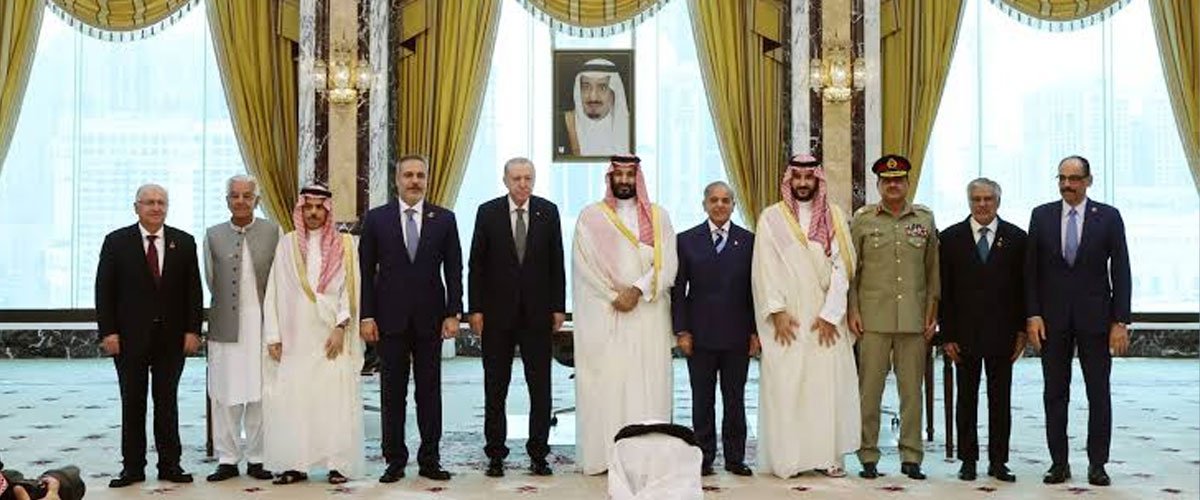
The comments came days after Pakistan, Saudi Arabia and Türkiye signed a Joint Defense Pact in Makkah, committing the three countries to closer security and defense cooperation. The agreement has been viewed as an attempt to institutionalize a trilateral security framework among three influential Muslim-majority states, although its precise operational scope and command structure remain unclear.
The pact also carries wider geopolitical significance because it comes at a time of growing uncertainty over the role of the United States in the security architecture of the Middle East and South Asia. Pakistan and Türkiye maintain close strategic ties with Washington while also developing stronger relations with China and other regional powers. Saudi Arabia, meanwhile, has traditionally relied heavily on US security guarantees but has in recent years sought greater strategic autonomy and diversified its partnerships.
For Iran, the emergence of a regional security arrangement involving Pakistan, Saudi Arabia and Türkiye is particularly significant because all three countries maintain important relations with Tehran. Iran’s relatively reassuring response suggests that it does not currently view the pact as an explicitly anti-Iranian alliance. At the same time, Tehran’s criticism of an American role in regional security reflects its longstanding position that regional states should develop their own security mechanisms without relying on external powers.