Author

Pakistan Faces Difficult Choices as Saudi-Houthi Conflict Intensifies
ISLAMABAD: Director General ISPR, Lieutenant General Ahmed Sharif Chaudhry has said that Pakistan will go to “any extent” to defend Saudi Arabia, adding that Islamabad’s commitment to the kingdom’s security is “unconditional”.
He made the remarks in an interview with Arab News, clips of which were posted on its social media account on X on Friday.
The remarks come as fighting between Saudi Arabia and Yemen’s Houthis has intensified, with the group making gains along Yemen’s Red Sea coast near the strategic waterway and launching missile and drone attacks on Saudi territory, while Riyadh has stepped up airstrikes against Houthi positions.
This week, the Saudi-led coalition battling the Houthis accused the rebels of targeting the holy city of Makkah, sparking outrage across the Muslim world. However, the Houthis swiftly rejected Riyadh’s report as a “lie”.
“Pakistan fully stands with the kingdom of Saudi Arabia, both diplomatically and physically. And I would like to underscore the word physically,” Lt Gen Chaudhry said in the interview with Arab News.
“We will go to any extent for the security of Haramain Sharifain and the kingdom of Saudi Arabia. To any extent as asked and required by our Saudi brothers,” he said.
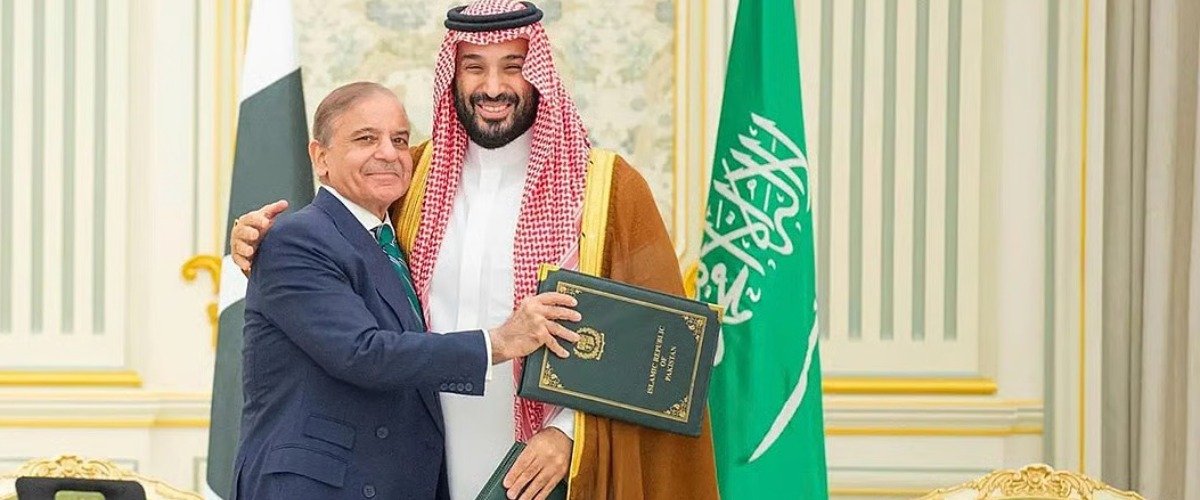
The options available to Pakistan range from diplomatic intervention and defensive assistance to direct military involvement, with the scale depending on how the conflict develops and, crucially, what Saudi Arabia formally requests. Pakistan’s Foreign Office said on Sept. 17 that Islamabad remains committed to implementing the Saudi and Makkah defence agreements, while also maintaining its mediatory role with Iran.
One immediate option is to strengthen Saudi Arabia’s air and missile defence without entering the Yemen war directly. Saudi Arabia is reportedly facing pressure on its stocks of missile interceptors and has sought assistance from several countries, including Pakistan. Islamabad could provide additional air-defence personnel, technical expertise, surveillance, intelligence-sharing and possibly military equipment, particularly to protect critical infrastructure and Saudi airspace.
A second option is for Pakistan to use its unusual diplomatic position with both Saudi Arabia and Iran to push for de-escalation. Islamabad has already urged Tehran to restrain Houthi attacks and has maintained that it can continue a mediatory role because of its relations with both sides. This could involve direct engagement with Tehran, Riyadh and other regional actors, potentially seeking arrangements to prevent attacks on Saudi territory, the holy cities and major shipping routes.
The most consequential option would be deployment of Pakistani forces under the Makkah Joint Defence Agreement, but this would represent a major escalation. The agreement states that an armed attack on one member is regarded as an attack on all three, although its practical mechanisms for collective military action are still developing. Recent analysis has noted that Saudi Arabia has not formally invoked the pact for military intervention, while Pakistan’s Foreign Office previously said no military response was under discussion.
Finally, Pakistan could seek a limited regional security role rather than direct participation in Yemen—for example, helping secure Saudi territory, supporting maritime security around the Red Sea and Bab el-Mandeb, or coordinating with Türkiye and other states on defensive measures. This would allow Islamabad to give practical meaning to Lt Gen Ahmed Sharif Chaudhry’s statement that Pakistan stands with Saudi Arabia “physically,” while avoiding, at least initially, a direct ground war against the Houthis inside Yemen. The renewed Yemeni fighting has already displaced more than 100,000 people and the Houthis have gained control of important stretches of the Red Sea coast, making direct Pakistani involvement potentially much broader than simply defending Saudi territory.