Author

Asim Munir’s Moment: Power, Paradox, and Pakistan’s Crossroads
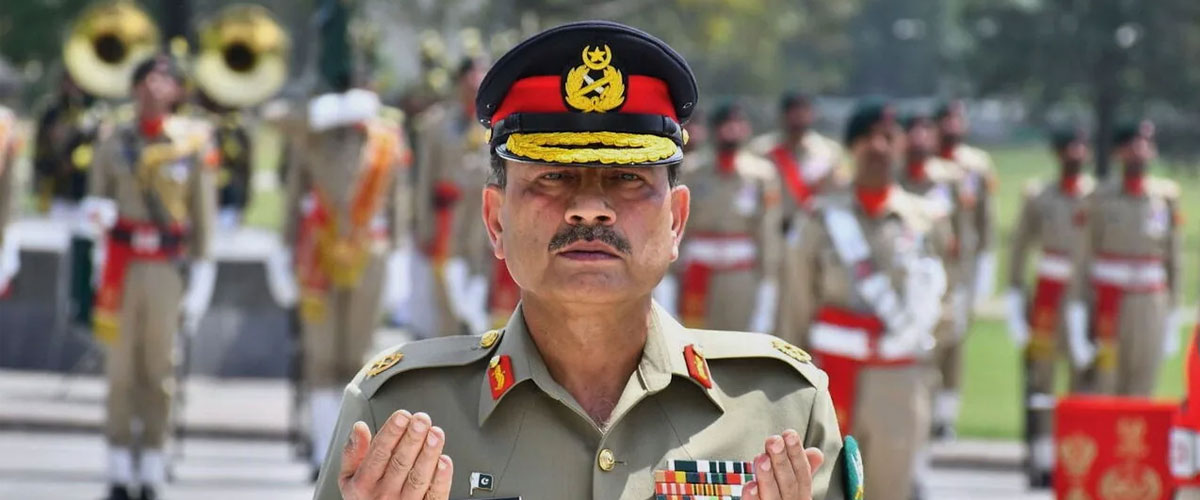
ISLAMABAD: The rise of Field Marshal Asim Munir at the international stage represents a rare paradox in Pakistan’s history: A military leader who has not staged a formal military takeover, and yet he enjoys an international stature which even a civilian prime Minister of the country would envy.
He has direct access to US President Donald Trump. He is playing a key role in backchannel diplomacy involving tensions with Iran. In this way he has positioned himself as a central figure in regional geopolitics— he has been engaging in diplomatic activity traditionally reserved for elected leaders. His rise to prominence at the international stage began when he led the Pakistani military in a 4-day conflict with India in May 2025. The conflict was perceived in Pakistan as a clear military victory for the county.
His prominent international stature was reinforced when President Trump invited him for lunch at the White House.
This trajectory repeats a familiar pattern in Pakistan’s political history, where military leaders use their international stature to consolidate their hold on power structure within society. But this raises a more consequential question: Is Munir the latest figure who would follow this script or will his moment indicate a potential shift in how power is exercised and consolidated in Pakistani society?
After attaining international limelight, the military leaders have often marginalized political opposition and intellectual dissent in society. Pakistan’s first military ruler, Ayub Khan started targeting political opponents, intellectuals, and poets after signing multiple defense agreements with Washinton.
The Famous leftist Poet, Faiz Ahmed Faiz had to spend more than three years in Ayub Khan’s jail. General Zia-ul-Haq, the military ruler in 1980s hanged his opponent and former Prime Minister Zulfiqar Ali Bhutto through a bogus trial, after US started funneling massive aid to Afghan Mujahideen against Soviet Occupation of their country. The third military ruler General Musharraf sent two of his main opponents—former prime ministers, Nawaz Sharif and Benazir Bhutto—into exile after he started receiving financial and military assistance from Washington as part of war against terror. These are not isolated incidents of Pakistani history; they reflect the structural dynamics where international backing reduces the cost of domestic coercion.
The May 2025 conflict with India was perceived in Pakistani society as a clear victory for Pakistan Armed Forces. The post-conflict situation brought glory for Field Marshal Asim Munir who was leading the Pakistani military in the four-day war. The government promoted him to the rank of Field Marshal—unprecedented in recent history of the country and created a special military command position for him to extend his leadership role across the military establishment.
Within weeks of Pak-India conflict, President Trump invited him to a lunch at White House and thus signaling a personal and strategic access which is rarely afforded to an army chief of a foreign country. Pakistan’s calibrated response during the Iran-US conflict and especially its decision to avoid direct military entanglement despite deep security relations with Gulf States helped preserve Munir’s lines of communication with Tehran.
All these developments placed Pakistan military leaders in a rare position in regional geopolitics: maintaining relevance in Washington and retaining credibility with Tehran. Pakistan’s role as a mediator between Iran and the United States started to take shape.
Will these developments reinforce old patterns of Pakistani politics, or will they create space for new direction?
Pakistan’s political and military leaders are facing two policy options:
They can use their foreign policy successes to consolidate their hold on power structures of the society and in the process marginalize the political opposition. This will lead to short-term stability and long-term stagnation of political processes and institutions.
Second option is to reduce internal conflict in Pakistan society and in this way focus on the revival of the economy. In their own rhetoric both the political and military leaders have in the past emphasized that long term political stability is essential for economic revival.
Pakistan political leaders might also spend their newly gained political capital in pursuing regional peace. At this moment they might move to revive their old idea of making Pakistan a regional connectivity hub between South Asia, Central Asia, and Southwest Asia.
This is, however, easier said than done. The civil-military imbalance is a major impediment. Tensions with India are another obstacle. Thirdly, global powers mostly see Pakistan as a security partner. For them accepting Pakistan as an economic hub will be politically difficult.
But if history repeats itself and this moment is used to consolidate political and military elites hold on power, we can be sure of three consequences: it will deepen political polarization, it will weaken civilian institutions, and Pakistan might never get rid of political instability eventually.
This moment of geopolitical success can either entrench old power structures or redefine them for posterity. Pakistan does not lack geopolitical relevance. It has attained it several times in the past few decades. What we lack is a political imagination to translate this geopolitical relevance into political stability at home.
Together Prime Minister Shehbaz sharif Field Marshal Asim Munir can make this a moment of turning Pakistan around. I know five years is a truly brief period for resolving all the political and military conflicts that infect Pakistani society. But we must start somewhere. This is the right moment.