Author

From Kashmir To The Gulf: Pakistan’s Expanding Security Calculus
Iran war has compelled Pakistan’s military planners towards expansion of their strategic thinking. They increasingly perceive Southwest Asia (Iran-Gulf-United States) and South Asia (India-Pakistan) as an interconnected zone of regional instability. This may not clearly be a new formal doctrinal shift.
Pakistan’s military doctrine remains primarily India-centric. But economic vulnerabilities, operational military trends and military signaling indicate the emergence of broader regional security framework.
There are several textual, strategic and structural evidence indicating this change in perception.
Thanks for reading The watchtower! Subscribe for free to receive new posts and support my work.
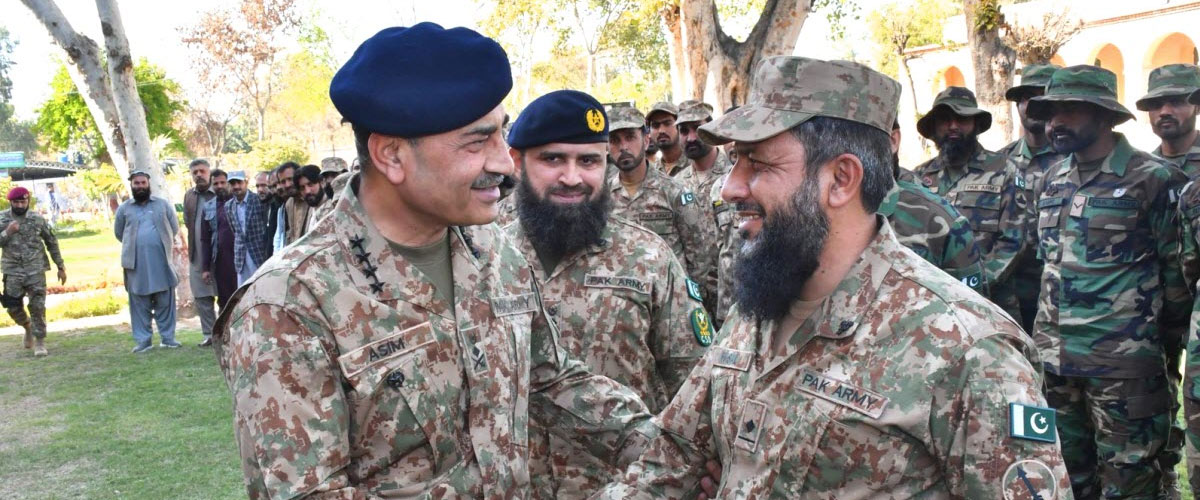
The latest of this evidence came at the conclusion of Corps Commanders Conference early this week, in the form of a lengthy statement, “Deliberating on the broader regional security environment, the Forum noted that emerging geopolitical developments carry significant implications for regional stability.
While underscoring the importance of restraint and avoidance of escalation, the Forum acknowledged Pakistan’s continued responsible role in advocating stability and supporting efforts aimed at preventing further deterioration of the situation. It reiterated that peace and stability in the region are intrinsically linked to collective restraint, responsibility and respect for sovereignty, reads the relevant paragraph of the statement issued by military’s media wing.
The context of this assertion is not mentioned in the statement. This paragraph has been deliberately kept ambiguous so that it could be interpreted either with reference to Iran-US military confrontation or in the context of Pak-India military tensions. Pakistan’s military establishment is widening its strategic lens from a narrowly “India-centric framework toward a broader systems-based understanding of regional instability”.
Within Pakistan Corps Commanders meeting is increasingly seen as a highest military decision-making forum, where country’s political, economic and military issues are periodically discussed. The statements issued at the end of these meetings are carefully calibrated strategic communication aimed at addressing multiple audiences. This time the security environment”, “emerging geopolitical developments”, “collective restraint” and “respect for sovereignty”.
The wording of the statement is kept deliberately non-specific.
Pakistan’s military doctrine traditionally revolves around India. Obviously, it’s force posture, deterrence strategy, prominent features of military procurement and strategic planning are all dominated by military developments on the Eastern front. Pakistan fought four wars with India over the course of its existence and all the four wars which were primarily land oriented.
Western Front has been treated as secondary in its military calculations, with planning oriented towards counter insurgency in the context of emerging security situation in Afghanistan and Pak-Afghan border areas. This is for the first time that Pakistan military is dealing with a potentially threatening situation emanating from the fear of collapse of Iranian state or regime following massive US-Israel bombing.
Pakistani planners have historically treated western and eastern fronts separately. Even during Gulf Wars, instability in the Western Front was treated simply as a diplomatic and economic concern. Now instability in the Gulf has now entered the military strategic calculations for the first time.
In the face of new geopolitical developments, country’s deterrence posture toward India is no longer insulated from Gulf instability. Instability in the Gulf could indirectly affect Pakistan’s military posture towards India.
A prolonged instability in the Gulf that would generate oil shocks could weaken crisis endurance of Pakistani state. Similarly persistent blockade of maritime routes could affect imports and exports of the country.
In past two regional wars—Pak-India war and Iran-Israel war—the technological convergence in operational patterns with the use of drones, precision missiles, Long-range strike systems and Cyber and ISR warfare have blurred old territorial boundaries between states and regions.
Same patterns of use of these emerging technologies have been witnessed in Iran-Israel exchanges, Red Sea conflict, Pakistan-India military conflict. Southwest Asia is not simply a region of military instability and threat.
Pakistan’s economy is linked to Southwest Asia through fluctuation in oil prices, its trade routes affect Pakistan’s oil supplies and exports, any instability in the Gulf can stop the flow of remittance from oil-rich Gulf societies where large number of Pakistani expatriates are working as a laborer, last but not the least tensions in the Gulf reflect on Pakistan’s sectarian problem.
These developments compel Pakistan’s strategic thinkers to come out of the continental thinking focused on South Asia. Pakistan’s maritime access to the larger Indian ocean and to the world passes through this region.
In this complicated security environment, economic vulnerabilities shape military confidence and crisis endurance of a state. Although this development is not new, Pakistani military have shown signs that they increasingly view economic stability as inseparable from national security. Now we have a clear demonstration of the fact that major military confrontation involving Iran or the Gulf directly affects oil prices, maritime trade and remittance flows, all the three directly impact Pakistan’s economic stability.
These shocks reduce fiscal space, increase political instability and at the same time complicate long-term defense planning. In this situation instability in the Gulf is not seen as a geopolitical event in faraway land, but as a development which could indirectly affect Pakistan’s military posture towards in India.
One statement alone, however, doesn’t prove doctrinal transformation. In the same vein we have acknowledge that the statements of Pakistan military media wings are deliberately kept vague as they are aimed at addressing multiple audiences. And there is no doubt that at the level of military doctrine, Pakistan’s main threat perception emanates from India. Besides, Western Front remains mostly reactive.
This much is clear that Pakistan doesn’t possess a fully integrated regional doctrine. But as the military’s media wing statement clearly indicates that Pakistan’s strategic vocabulary is evolving. Instead of talking merely about regional and border tensions, the media wing statements now mention emerging regional geopolitical environment as cause of concern.
Such terminology is employed only when multiple crises are emerging in the broader region. This much is clear that Pakistan military now seems to be concerned more with interconnected instability stretching from the Gulf to South Asia.
Analysts are predicting that future security thinking might be shaped more by economic shocks, emergence of new military technology and regional interdependence. In an era of drones, overlapping geopolitical crises, the generals of Pakistan Army may be discovering that the Gulf and Kashmir can no longer be treated as separate strategic worlds.