Author

FO Welcomes Indian Voices Supporting Dialogue With Pakistan
ISLAMABAD: Pakistani Foreign Office has expressed the hope that warmongering” and “belligerence” being witnessed in the neighboring country for a long time would “fade away”, after voices in India started to call for keeping the option of talks with Pakistan open.
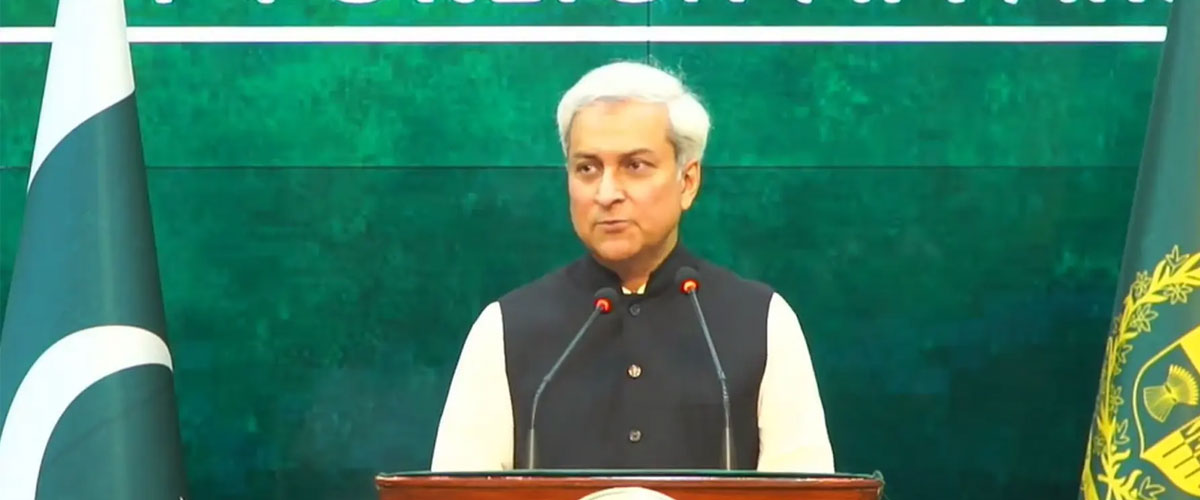
During weekly briefing on Thursday the Foreign Office spokesman termed the voice in New Delhi supporting talks with Pakistan, a positive development.
He made these remarks during a weekly FO briefing, where he was asked to share views about voices in India calling for dialogue with Pakistan.
The media men asked the Foreign Office spokesman to comment on statements coming from India including a recent one by former Indian army chief Gen (retired) Manoj Naravane, who supported the Rashtriya Swayamsevak Sangh (RSS) secretary general’s remarks calling for keeping the window for dialogue between Islamabad and New Delhi open.
In response to the question, Andrabi said: “The voices within India calling for dialogue are obviously a positive development; we hope that sanity will prevail in India, and warmongering, the belligerence that has been emanating for the past several months and even beyond, for past years, will fade away and pave the way for more such voices.”
When asked about reports in the Indian media about backchannel talks going on between New Delhi and Islamabad, the FO spokesperson replied: “About track two or backchannel – well I am not aware of that and do not wish to comment on those. If I were to comment, there would be no backchannel. Backchannel or track two, the name is self-explanatory.”
In the recent past, ties between India and Pakistan particularly deteriorated after New Delhi blamed Islamabad without evidence for an attack on tourists in occupied Kashmir’s Pahalgam in April 2025. For its part, Pakistan strongly denied the allegations and called for a neutral investigation.
Two days after the Pahalgam attack, India had taken a series of aggressive measures against Pakistan, including unilaterally suspending the critical Indus Waters Treaty (IWT). Pakistan retaliated by suspending all kinds of trade, closing its airspace for Indian flights and shutting down the Wagah border.
Subsequently, New Delhi launched deadly overnight air strikes on Pakistan on May 6 over allegations about the Pahalgam attack. In retaliation, Pakistan Air Force downed several Indian planes in air-to-air combat. The initial tally of the downed jets was announced as five and later raised to eight.
After tit-for-tat strikes on each other’s airbases, it took American intervention on May 10 for both sides to finally reach a ceasefire.