Author

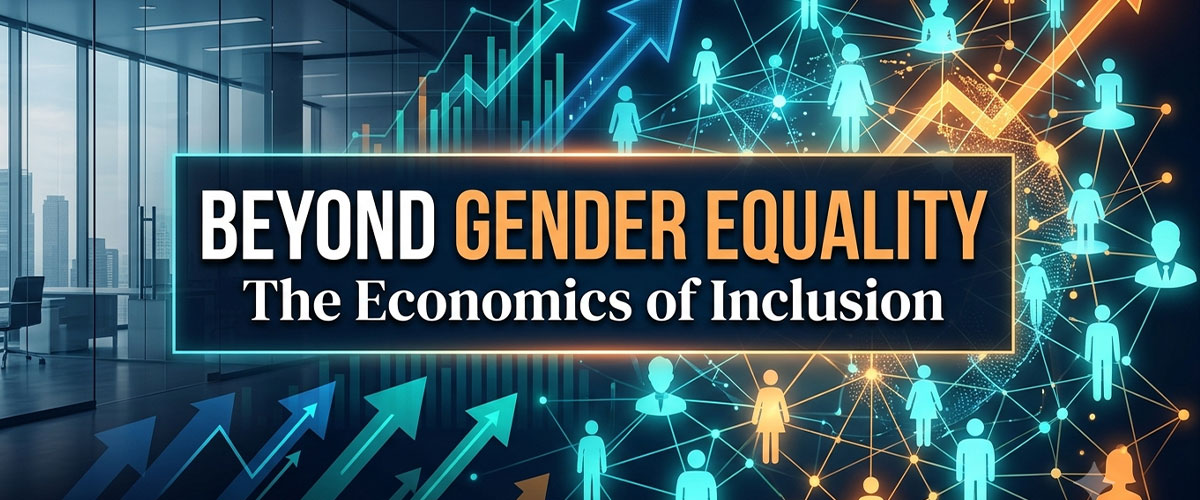
Beyond Gender Equality: The Economics of Inclusion
Why Pakistan’s Next Economic Reform Must Be Inclusive
Pakistan’s economic conversation is remarkably consistent. Governments change, economic teams rotate, and policy priorities evolve, yet the debate almost always returns to the same themes: fiscal deficits, taxation, inflation, exports, industrialisation, foreign direct investment, and macroeconomic stability. These are undoubtedly important. But amid the search for higher growth, one of the country’s most transformative economic reforms remains largely invisible. It is invisible not because it lacks economic value, but because it continues to be framed primarily as a social concern rather than a driver of national productivity.
That reform is economic inclusion.
Too often, inclusion is viewed as a social policy—a matter of welfare, affirmative action, or equal opportunity. It is discussed in the context of women, persons with disabilities, youth, marginalized communities, or underdeveloped regions, but seldom as an economic strategy in its own right.
This narrow perspective has obscured a larger truth. Inclusion is not simply about expanding rights; it is about expanding productivity. It is not merely a social aspiration but an economic necessity. Countries do not maximize growth by relying on a fraction of their human capital. They grow by enabling as many people as possible to participate, innovate, work, invest, and contribute.
Pakistan’s next generation of economic reform should therefore begin with a simple question: How can we bring more people into the productive economy?
Growth Begins with Participation
Economic growth is often measured through rising GDP, expanding exports, or increasing investment. Yet these indicators reveal little about who is participating in that growth.
A country cannot achieve its full economic potential while millions remain excluded from productive activity. Every educated woman unable to enter the workforce, every skilled young graduate unable to secure meaningful employment, every entrepreneur without access to finance, every person with a disability facing barriers to work, and every remote community disconnected from markets represents lost productive capacity.
The cost of exclusion rarely appears in national accounts, but it is reflected in lower productivity, weaker innovation, slower business expansion, and reduced household incomes. An economy that leaves large segments of its population behind is, by definition, operating below its potential.
The Inclusion Dividend
Economists frequently discuss demographic dividends, export dividends, and investment dividends. Pakistan, however, possesses another largely untapped opportunity: the inclusion dividend.
An inclusion dividend is created whenever barriers preventing people from participating in the economy are removed. Every individual who transitions from exclusion to productive employment, entrepreneurship, or formal economic activity contributes to national output, expands the tax base, stimulates consumer demand, and strengthens economic resilience.
This is not redistribution of opportunity; it is the creation of new economic value.
Inclusion enlarges the economy rather than merely reallocating existing opportunities. It enables businesses to draw from a broader talent pool, increases labour productivity, encourages innovation, and strengthens domestic markets. Simply put, the economy grows because more people are helping to build it.
Pakistan’s Invisible Economic Deficit
Pakistan has invested heavily in physical infrastructure over the past two decades. Roads, motorways, ports, industrial zones, and energy projects have rightly been viewed as essential foundations for growth.
Yet physical infrastructure alone cannot unlock economic potential if human capital remains underutilized.
Female labour-force participation in Pakistan remains only around one-quarter of working-age women, significantly below male participation and well below many comparable economies. This represents not merely a gender gap but a substantial loss of productive capacity.
Similarly, millions of young Pakistanis enter the labour market each year, yet many struggle to find productive employment matching their education and skills. Instead of becoming an economic dividend, unemployment and underemployment risk becoming structural constraints on growth.
Financial exclusion presents another challenge. Many women, rural entrepreneurs, home-based businesses, and small enterprises continue to face limited access to formal financial services, preventing them from investing, expanding, and creating employment.
Digital exclusion compounds these challenges. As economies increasingly depend on digital platforms for education, finance, commerce, and public services, unequal access to technology risks creating a new layer of economic inequality.
Each of these gaps reduces national productivity. Together, they constitute one of Pakistan’s least recognised economic deficits.
Beyond Roads and Power Plants
Infrastructure remains indispensable for development. Roads connect markets. Electricity powers factories. Ports facilitate trade.
But modern economies also require another form of infrastructure: institutional inclusion.
Quality education, accessible healthcare, digital connectivity, affordable childcare, financial services, disability-friendly workplaces, and skills development systems are equally important because they connect people to economic opportunity.
When these institutions function effectively, participation expands. Labour markets become more dynamic. Entrepreneurship flourishes. Businesses gain access to a wider pool of talent. Governments benefit from higher revenues generated through increased economic activity rather than higher taxation alone.
Inclusive institutions are therefore productive institutions.
Breaking the Policy Silos
One reason inclusion receives limited attention is that Pakistan’s institutional framework often separates economic policy from social policy.
Economic ministries focus on investment, exports, taxation, and industrial growth. Social-sector ministries focus on education, gender, poverty alleviation, and community development.
In reality, these objectives are inseparable.
A finance ministry seeking higher productivity should also be concerned with labour-force participation. A commerce ministry promoting exports should recognize that competitiveness depends on the quality and diversity of the workforce. Industrial policy should consider whether businesses can access skilled workers from all segments of society. Planning should integrate inclusion as a driver of sustainable economic growth rather than treating it as an afterthought.
The strongest economies do not compartmentalize inclusion; they mainstream it.
From Social Policy to Economic Strategy
Reframing inclusion as an economic reform requires a broader policy vision.
Labour-market reforms should encourage greater workforce participation. Skills development must align with changing economic needs. Financial inclusion should expand access to affordable credit for small businesses and entrepreneurs. Digital infrastructure should reach underserved communities. Public and private institutions should become more accessible to persons with disabilities. Investments in childcare and safe workplaces should be recognised as economic enablers rather than social expenditures.
None of these initiatives represents charity.
Each is an investment in productivity.
Each strengthens economic resilience.
Each expands the country’s productive capacity.
Growth That Includes Lasts Longer
The international development discourse has gradually shifted beyond measuring success solely through GDP growth. Increasingly, attention is focused on the quality, resilience, and inclusiveness of economic progress.
Pakistan should embrace the same perspective.
The question is no longer simply whether the economy is growing.
The more important question is whether more Pakistanis are participating in that growth.
Economic reforms that exclude large segments of society produce limited and often unsustainable gains. Reforms that broaden participation create stronger labour markets, more competitive businesses, greater innovation, higher household incomes, and a more resilient economy.
Pakistan’s greatest untapped resource is not hidden beneath its soil, nor does it lie solely in its strategic geography. It resides in the productive potential of millions of citizens whose talents remain underutilized because barriers continue to limit their participation.
The country’s next economic breakthrough may therefore come not from another fiscal package, another industrial incentive, or another investment summit. It may come from recognising that inclusion is itself an economic reform.
The most successful economies are not those that create opportunities for a fortunate few. They are those that enable the broadest possible participation in national prosperity.
If Pakistan is serious about achieving sustainable and inclusive growth, the missing reform is no longer difficult to identify.
Pakistan has debated economic reforms for decades. The next breakthrough may not come from discovering a new policy instrument, but from recognising the economic potential of people who have long remained outside the country’s growth story. Inclusion is not simply good social policy—it is smart economics, and it may be Pakistan’s most important unfinished economic reform.