Author

US Lawmakers Meet Field Marshal Asim Munir, Reaffirm Commitment to Stronger Pakistan-US Ties
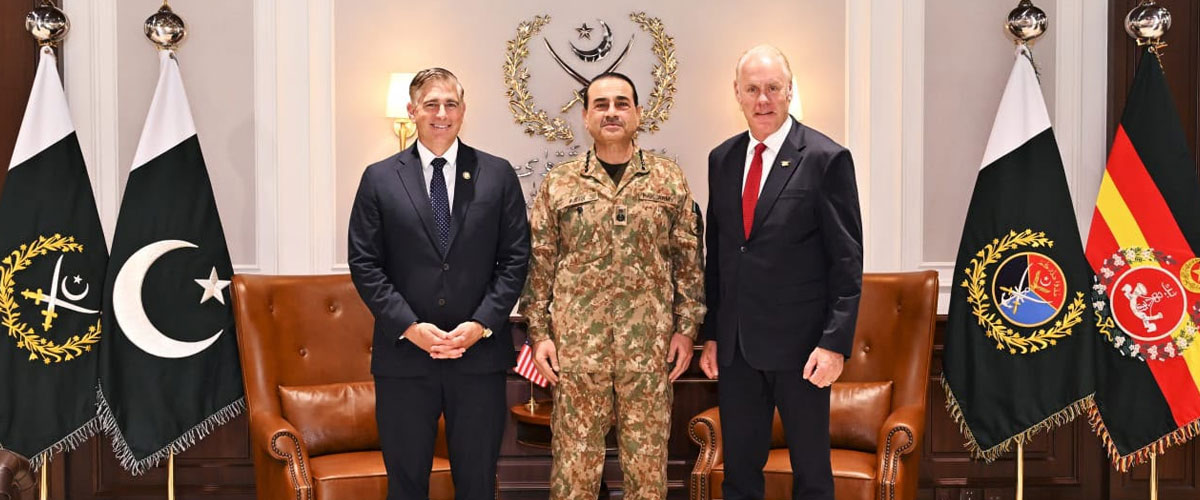
ISLAMABAD: The visiting US public representatives in a meeting with Field Marshal Asim Munir acknowledged the critical role of Pakistan in regional stability and economic resilience.
“The visiting dignitaries acknowledged Pakistan’s critical role in regional stability and economic resilience. Recognizing the professional backgrounds and insights of the delegation, both sides discussed potential opportunities for bilateral economic engagement, private sector partnerships and enhancing bilateral trade ties” reads a press release of ISPR.
Mr. Ryan Keith Zinke, Member House of Representatives (State of Montana) and Mr. Michael James, Member House of Representatives (State of Washington) called on Field Marshal Syed Asim Munir, NI (M), HJ, Chief of Army Staff & Chief of Defence Forces, at General Headquarters (GHQ), Rawalpindi.
During the meeting, discussions focused on matters of mutual interest, regional security, bilateral defense cooperation and avenues for enhancing economic collaboration and prosperity.
The Field Marshal highlighted Pakistan’s vast economic potential, emphasizing that sustainable regional stability is deeply anchored in economic growth, trade expansion and connectivity. He underscored Pakistan’s ongoing structural reforms aimed at fostering a business friendly environment and attracting foreign investment.
The visiting delegation thanked the military leadership for the warm hospitality and expressed a shared commitment to promoting deeper economic, commercial and institutional linkages between the United States and Pakistan.
Since the beginning of 2025, Pakistan-United States relations have undergone a noticeable improvement after several years of strained engagement. While counterterrorism and security cooperation remain important pillars of the relationship, both countries have increasingly sought to broaden their engagement to include trade, investment, critical minerals, energy, information technology and climate resilience. High-level contacts between military and civilian officials have also become more frequent, reflecting a mutual desire to stabilize and expand bilateral ties.
The Pakistan Army has continued to play a prominent role in managing the strategic dimension of the relationship. Field Marshal Syed Asim Munir’s interactions with senior American political and military leaders have reinforced defense-to-defense cooperation while also emphasizing economic diplomacy.
Pakistani officials have consistently argued that long-term regional stability depends not only on security cooperation but also on economic development, regional connectivity and increased private-sector investment. Washington, meanwhile, has acknowledged Pakistan’s importance in South Asian stability, counterterrorism efforts and broader regional security dynamics.
The visit by U.S. lawmakers Ryan Zinke and Michael Baumgartner reflects the growing role of congressional engagement in strengthening bilateral relations beyond the executive branch. Such visits provide opportunities to promote commercial partnerships, encourage greater business-to-business contacts and build support in the U.S. Congress for expanding economic cooperation with Pakistan. Analysts view sustained congressional exchanges as an important complement to government-to-government diplomacy, particularly at a time when both countries are seeking a more diversified and economically focused partnership while maintaining cooperation on regional peace and security.