Author

OIC Welcomes Saudi-Türkiye-Pakistan Defense Pact
ISLAMABAD: The Organization of Islamic Cooperation (OIC) welcomed Friday the signing of the Mecca Joint Defense Agreement among Saudi Arabia, Türkiye and Pakistan.
OIC Secretary-General Hissein Brahim Taha expressed his “strong appreciation and support” for the agreement, describing it as an “important strategic step” reflecting the three countries’ commitment to strengthening regional and international cooperation, according to a statement by the organization.
Taha said the agreement constitutes “a fundamental pillar for supporting security and stability in the region and across the Muslim world.”
He added that it embodies a shared determination to address growing security challenges and strengthen solidarity and constructive partnerships among OIC member states.
The OIC chief also praised the efforts and leadership of the three countries that culminated in the signing of what he called a “historic agreement.”
He expressed hope that the pact would contribute to achieving peace and prosperity in the region and the wider international community.
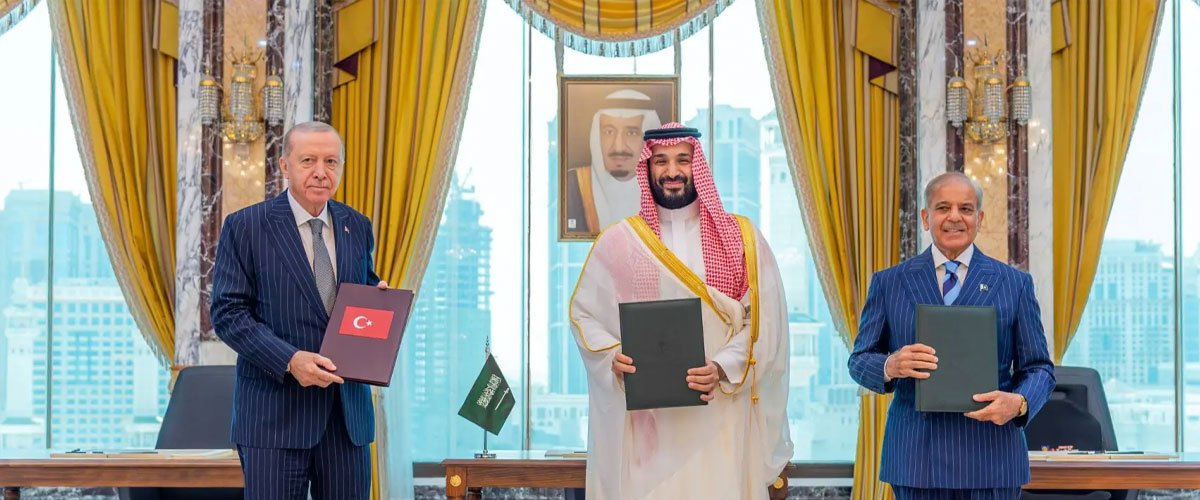
On Friday, Türkiye, Saudi Arabia and Pakistan signed a joint defense agreement at a trilateral summit in Mecca, pledging to strengthen collective security, deepen defense cooperation and promote peace and stability in the region and beyond.
The Mecca Joint Defense Agreement was signed by Turkish President Recep Tayyip Erdogan, Saudi Crown Prince Mohammed bin Salman and Pakistani Prime Minister Shehbaz Sharif during the summit held at Al-Safa Palace.
The agreement aims to strengthen collective deterrence against any act of aggression and stipulates that an armed attack against any one of the three countries shall be regarded as an attack against them all, the officials added.
The Mecca Joint Defense Agreement brings together three major Muslim-majority states with significant strategic and military capabilities, reflecting growing efforts to deepen security cooperation within the Muslim world. Saudi Arabia, Türkiye and Pakistan have long maintained bilateral defense and political ties, including military training, exercises and defense-industry cooperation, but the trilateral pact gives their security relationship a more formal strategic framework.
The agreement comes amid a complex regional security environment marked by conflicts and tensions across the Middle East and South Asia. Saudi Arabia remains a key regional power and energy producer, Türkiye has expanded its strategic and defense role across the Middle East and beyond, while Pakistan possesses one of the region’s largest armed forces and a nuclear deterrent.
Their closer coordination could therefore have implications for regional deterrence, military cooperation and the balance of power.
The pact also carries broader political significance for the Organization of Islamic Cooperation, which represents 57 member states. The OIC’s endorsement suggests that the agreement is being viewed not merely as a trilateral defense arrangement but as a potential instrument for greater security coordination among Muslim countries. Its practical significance, however, will depend on how the three countries translate the pledge of collective security into concrete mechanisms for defense cooperation and respond to any future armed conflict involving one of the signatories.