Author

The “Well Done” Problem
When journalists internalize the logic of power, they stop watching the state and start celebrating it
“One of the most significant developments of recent times. All three countries and the region will benefit from this agreement. Well done!” wrote prominent journalist, Fahd Husain in a tweet, which he posted on social media platform on the afternoon of August 7, 2026. I saw the post at 7pm the same day.
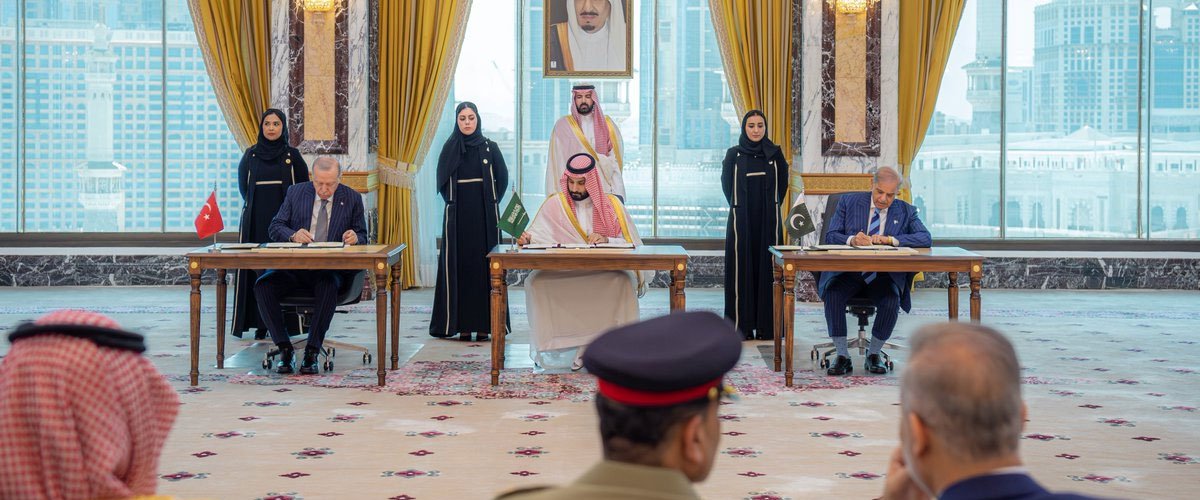
It was posted along with the press release of Foreign Office titled, “Makkah Al-Mukarramah Summit for Joint Defense” announcing the signing of Türkiye-Saudi-Pakistan joint defense pact at the Royal palace of Saudi Crown Prince.
The first part of Mr. Husain’s tweet is celebratory in tone. It sounds like a statement reflecting pride in what has happened. Second part a two-word sentence—Well done–sounds like coming from someone in command. This is the typical tone of people in Islamabad who regularly rub shoulders with powers that be.
For me this tone is very familiar as it is familiar to everyone who has spent a lifetime under state machinery’s wrath. But Mr. Husain knows very well that he is no commander. He is a small cog in a very large machine which has been created to serve two purposes. First, to massage the ego of those in power and secondly to mass disseminate a narrative which professionals like Mr. Husain craft for them.
Pakistani journalists who have a tryst with those sitting at the apex of state machinery develop this “Well done problem”. They think they have a share in state’s sovereignty. For them celebrations on every foreign policy success becomes a norm. On such occasions, perhaps out of excitement, they start speaking to the state or congratulating the state machinery as if they are talking to their subordinates. In this massive outpouring of euphoric emotions, the journalist in them forgets about their real job: to question, interrogate and investigate power.
For power the most useful journalist is not the one who receives orders from them. It is the journalist who no longer needs to receive the orders. Because he has internalized the logic of power. This type of journalist is more useful for the state machinery than the mere sycophants because he or she takes power’s assumptions as his or her independent thought. I label them as court intellectuals.
For them the signing of Türkiye-Saudi-Pakistan Defense Pact is a moment when Pakistan attained invulnerable political deterrence vis-à-vis its enemy and became increasingly secure against external threats. The fact that this exactly is the moment when a large segment of Pakistan citizenry became insecure vis-à-vis Pakistan state machinery is insignificant for them.
Irony of this “Well done problem” is that at this point in our history we may be strengthening our external security while at the same time weakening the internal political foundations of the state upon which security ultimately depends. Pakistan may have nuclear weapons, large and powerful military, power allies and defense agreements with sincere friends like Saudi Arabia and Türkiye and still pushes its citizenry towards an insecure state of mind.
Congratulating the Pakistani military for achieving the success of friendly and close relations with the United States on the one hand and Türkiye and Saudi Arabia on the other hand is only part of the story. Pakistan now sits at the center of a dense network of strategic relations. Anyone, however, engaged in the exercise of serious military and security planning for Pakistan cannot afford to ignore the fact that major threats to Pakistan are emanating from internal sources. TTP and Baloch rebels are prime examples. Bigger danger stems from the fact that a state which risks alienating large segments of its own citizenry may be contributing to the process of delegitimizing its own authority.
In my opinion the Pakistani state is facing a twin problem of first losing the monopoly on violence and secondly losing its legitimacy to use violence against armed groups in several parts of territory under its control.
The “Well done” squad will never connect the dots to make the military leaders and public at large realize that the Pakistani military and diplomatic establishment is acquiring strategic and diplomatic space at the international stage at the very moment when their relations with their population is increasingly becoming coercive.
Massive protest rallies in Azad Kashmir and the use of violence against them by the state machinery tell a very dreadful story. While it is difficult to ignore violence perpetuated by the protests in Azad Kashmir, it is also difficult to avoid the question of why a state which has accumulated so much coercive power and external security capacity finds itself in the awkward position of confronting its own citizens as security threats.
Second example of use of state’s repressive tactics is the treatment meted out to PTI as a political party and its cadre in the urban areas of Punjab. Any serious military planner will never delink these issues from problems of national defense and security. Unless “Well Done” squad feed them a hunky-dory picture to the military leaders and planners.
The external alliances are going to further strengthen the position of military leadership which has numerous precedents, before them, of their predecessors using their international connection to strengthen their grip on the power structure of the society and state. Are we looking at another decade of dictatorship? I think it is not that simple.
We may be looking at less democratic accountability and even less civilian institutional capacity to manage policy making processes on their own. More military strength and stronger deterrence against external threats would result in such outcomes primarily because this is the dominant pattern of political history. In the past when military leaders acquired international legitimacy, they have always curbed trends of political dissent.
We don’t even have to go back into history to ascertain this trend. We know very well that diplomatic legitimacy for political and military leaders has been followed by a crackdown in Azad Kashmir. No surprise we will see a more insecure citizenry in our society.
“Well done” squad is part of the problem. They create a shadow reality through which society and people are fed on the outcomes of the glamorous and rarefied world of international diplomacy. Power and elitist culture become the norms, and the powerful world of media get people enamored by showing glittering palaces and sumptuous banquets. The flowery language and verbosity of the “Well done” squad leads the naïve viewers into the wonderland of diplomacy.
The “Well done” squad only celebrates the state’s growing power and fails to inquire how this power is experienced by the people on the street. In this way journalism is submerged into the structures of state machinery and ceases to be a watchdog.