
Author

Gillani Takes Oath as AJK PM Amid PML-N Revolt Over His Nomination
ISLAMABAD: The revolt within the PML-N’s AJK chapter over Barrister Syed Iftikhar Ali Gillani’s nomination is more than a routine disagreement over the distribution of offices.
It has exposed a basic tension between the party’s centralised decision-making in Lahore and Islamabad and the expectations of its regional leadership in Muzaffarabad. Shah Ghulam Qadir, the PML-N’s AJK president, and former prime minister Raja Farooq Haider reportedly objected when they were informed that Nawaz Sharif had chosen Gillani. Both had expected the party to follow the earlier formula under which the regional leadership would have a decisive say in selecting the prime minister. Qadir went further, boycotting the assembly session and invoking Nawaz Sharif’s own slogan of “respect for the vote.”
The controversy was sharpened by the manner of Gillani’s elevation. He had lost his direct contest in Muzaffarabad to PPP candidate Mukhtar Ahmed Abbasi and returned to the assembly only through a reserved technocrat seat before being selected for the region’s highest political office. That sequence gave the disgruntled PML-N leaders a political argument: a party that had won a substantial mandate in the direct elections had bypassed several elected and senior figures to choose someone who had initially been rejected by voters in his own constituency. Whether or not this criticism is fair, it makes the dispute fundamentally about political legitimacy and the relative weight of an electoral mandate versus the authority of the central party leadership.
The immediate revolt did not prevent Gillani’s election, but the voting numbers demonstrated that the party’s victory did not erase the political cost of the dispute. Gillani secured 30 votes against the PPP’s 14, while Shah Ghulam Qadir stayed away and the speaker did not vote. The fact that the PML-N could still install its nominee reflects its commanding position in the assembly, but a parliamentary majority is not the same thing as internal cohesion. Gillani begins his tenure knowing that one of the most important organisational figures in the party’s AJK structure publicly dissociated himself from the process that brought him to power.
At a deeper level, the episode raises an old question about the nature of political power in Azad Kashmir: who actually controls the mandate—the elected regional leadership or the central leadership of Pakistani political parties? The PML-N has historically depended on strong local personalities in AJK, and leaders such as Qadir and Haider have their own political constituencies and organisational networks. By overruling them on the most important decision after an election victory, the central leadership may have secured a preferred candidate but also risked creating the impression that AJK’s mandate can be managed from outside the region. This is particularly sensitive in AJK, where questions of autonomy, representation and local political dignity carry far greater significance than an ordinary intra-party contest.
For Gillani, therefore, the real challenge begins after the oath. His speech focused on governance, unemployment, education and healthcare, but he will first have to consolidate his own party before he can effectively address these issues. The central leadership can impose a prime minister, but it cannot indefinitely substitute for cooperation from the regional political organisation. If Nawaz Sharif and Shehbaz Sharif move quickly to reconcile Qadir, Haider and other dissatisfied leaders, the revolt may remain a short-lived protest over a single appointment. If the grievances harden, however, Gillani could find himself heading a government with a comfortable legislative majority but a divided ruling party—an arrangement that could make every major decision a test of his political authority rather than his administrative agenda.
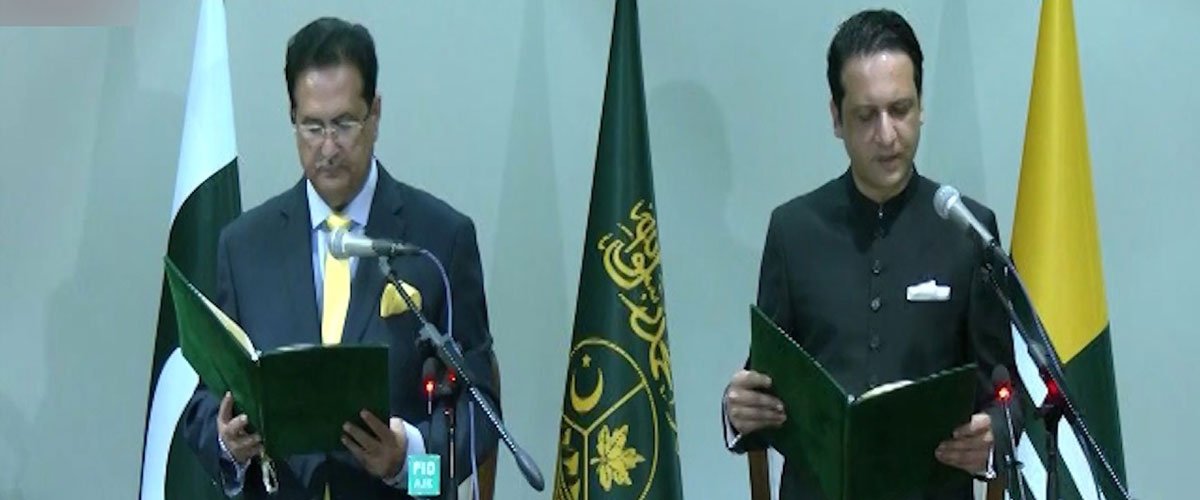
Meqnwhile PML-N’s Barrister Syed Iftikhar Ali Gillani was sworn in as Azad Jammu and Kashmir’s prime minister on Friday.
Gillani took oath at a televised ceremony, where he expressed gratitude to PML-N supremo Nawaz Sharif, Prime Minister Shehbaz Sharif, Punjab Chief Minister Maryam Nawaz and the party’s senior leadership.
Addressing the gathering, the newly elected prime minister said he was thankful for the leadership’s “affection and faith” in him and pledged to uphold that trust.
“I am thankful for the leadership and party’s affection and faith in me, and I assure you that even if I have to work day and night, I will uphold this faith,” Gillani said.
He urged members of the Legislative Assembly to cooperate with him, stressing that “we must move forward together and build an AJK that is exemplary for the whole world”.
“Ours is a small region,” Gillani said, noting that “similar to the rest of the country, AJK also has governance issues and unemployment”.
“Why does anyone work in this country? It is so they can put food on the table, give their children a better education and afford to pay hospital bills,” he said, stressing that the three points were “the basis on which his government will move forward”.
He emphasised that the youth must be provided employment opportunities. “We have to take all possible efforts to ensure employment for the youth so they may not be led astray and continue on a path to a brighter future”.
Gillani stated that the hospitals in the region also needed improvement. “If we address these three things to even a minor extent, many of our tensions will be resolved.”
