Author

Pakistan Rejects India’s Claims on Kashmir Status, Reaffirms UN-Recognized Dispute
ISLAMABAD: Pakistani Foreign Office on Monday said that Pakistan categorically rejects India’s baseless assertions regarding the status of Jammu and Kashmir which are contrary to internationally recognized facts.
“India’s unilateral actions and continued illegal occupation cannot alter the internationally recognized disputed status of Jammu and Kashmir” said the Foreign Office spokesman in a statement issued from his office on Monday morning.
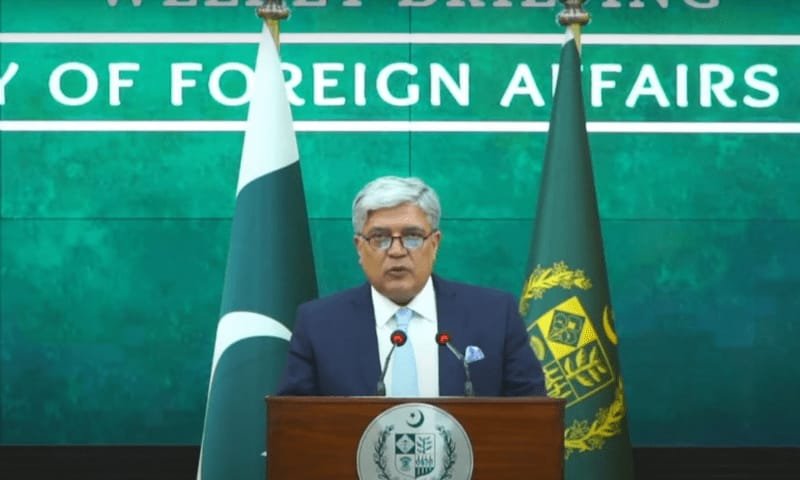
Responding to media queries regarding the statement issued by India’s Ministry of External Affairs on the map of disputed Jammu and Kashmir region, the Spokesperson of the Ministry of Foreign Affairs, Ambassador Sajjad Haider Khan, stated:
“Pakistan categorically rejects India’s baseless assertions regarding the status of Jammu and Kashmir which are contrary to internationally recognized facts . India’s unilateral actions and continued illegal occupation cannot alter the internationally recognized disputed status of Jammu and Kashmir”
Jammu and Kashmir dispute remains one of the oldest unresolved, internationally recognized disputes on the agenda of the United Nations Security Council. The relevant UN resolutions stipulate that its final disposition must be made in accordance with the relevant Security Council resolutions and the will of the Kashmiri people, expressed through a free and impartial plebiscite under UN auspices.
The official United Nations maps, which depict Jammu and Kashmir as a disputed territory, remain the only cartographic representation of its current legal status. India’s so-called official maps and unilateral claims of sovereignty have no bearing on the status of the disputed territory.
Pakistan urges the international community to ensure that India immediately stops human rights violations in the Indian Illegally occupied Jammu and Kashmir, and fulfils its commitment towards the realization of the right to self-determination of the Kashmiri people, in line with the relevant UNSC resolutions.
The Jammu and Kashmir dispute has remained at the center of tensions between Pakistan and India since the partition of the subcontinent in 1947. The two nuclear-armed neighbor’s have fought multiple wars and several military confrontations over the territory, which is divided between Pakistan and India, while China also controls parts of the wider former princely state.
The dispute returned sharply to international attention after India revoked the special constitutional status of Indian-administered Jammu and Kashmir in August 2019 and reorganized the territory into federally administered units. Pakistan rejected the move, arguing that India could not unilaterally alter the status of a territory whose final disposition remains disputed under relevant United Nations Security Council resolutions.
Relations between Islamabad and New Delhi have since remained deeply strained, with Kashmir continuing to be one of the principal obstacles to any meaningful improvement in bilateral ties. Pakistan has consistently maintained that a durable settlement of the dispute must be based on UN Security Council resolutions and the aspirations of the Kashmiri people, while India maintains that the issue is a bilateral matter and that Jammu and Kashmir is an integral part of India.